
Home › Products › Low pressure valves › Globe valves › ANSI 150 SS316
ANSI 150# flange - 150 PSIANSI 150 SS316 globe valve, 1" to 4"
A rising‑stem globe valve for throttling and isolation, 1" to 4" (DN25 to DN100), with ANSI 150# flange ends in Stainless steel — A182 F316 forged, A351 CF8M cast. Rated 150 PSI to −20 °C to 425 °C as published on the small band, 425 °C on the large, built to API 602 and BS 5352 and tested to API 598.
The ANSI 150 SS316 globe valve
Built to API 602 and BS 5352, with ANSI 150# flange ends.
A rising‑stem globe valve for throttling and isolation, in 1" to 4" (DN25 to DN100), with ANSI 150# flange ends and a body in Stainless steel — A182 F316 forged, A351 CF8M cast. Rated 150 PSI, designed and manufactured to API 602 and BS 5352, inspected and tested to API 598.
Inside, flow turns up through a seat opening, past a disc that lifts squarely off the seat, and turns down again. The stem moves the disc towards or away from the seat, so the gap changes smoothly with stem position and a flow can be set and held. That is the job a gate valve cannot do — a gate parked part open vibrates and wears its seat. The cost is pressure drop even fully open, because the path turns twice. Globe against gate.
- The two bands are genuinely different valves. 1"–1½" is a forged F316 compact body with the seat machined into it; 2"–4" is a cast CF8M body with a separate disc, back seat and gland. Both are 316‑grade stainless and both are published in full below — order spares against the band your valve came from.
- The small band is rated to −20 °C, as published. It matters only on genuinely cold duty; if you are near it, ask us to confirm with the factory before ordering.
- Part numbers read VL‑S‑GL‑, which is correct. GL is this manufacturer’s globe valve code. The forged steel version’s codes are confirmed with the factory on enquiry.
- 425 °C on a stainless valve, because it seals metal to metal. There is no polymer seat here. A SS316 ball valve in the same material stops at 150 °C, and the reason is entirely its PTFE seat.
- The handwheel is A197 or A216 WCB, not stainless. Item 15 on the forged band and item 16 on the cast one. Dry, outside the pressure boundary, and paintable.
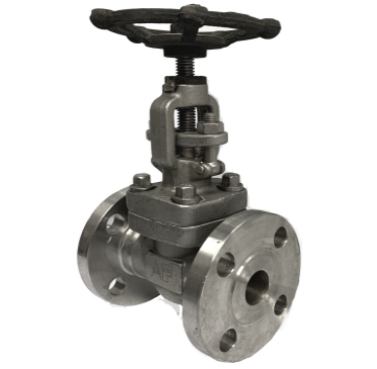
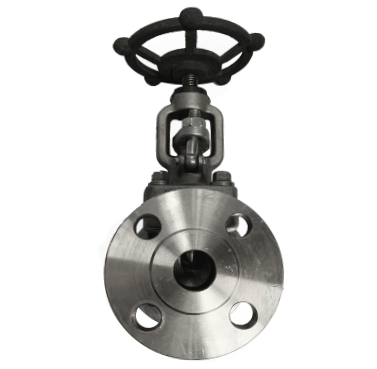
Three angles on the same valve. Photographs of the stocked item, not renders.
Specification
Everything that goes on a purchase order.
| Size range | 1" to 4" (DN25 to DN100) |
| End connection | ANSI 150# flange |
| Working pressure | 150 PSI |
| Maximum working temperature | −20 °C to 425 °C as published on the small band, 425 °C on the large |
| Body material | Stainless steel — A182 F316 forged, A351 CF8M cast |
| Trim | F316 disc, stem, gland and pin |
| Design and manufacture | API 602 and BS 5352 |
| End dimensions | ASME B16.5 |
| Inspection and test | API 598 |
| Shell or body test | 3.0 MPa |
| Seal test | 2.2 MPa |
| Gas tightness test | 0.6 MPa |
| Stem | Rising stem, handwheel operated |
| Packing | Graphite |
| Duty | Throttling and isolation — designed to run part open |
| Flow direction | Normally flow under the seat — check the body arrow |
| Stock | Held in Malaysia or Singapore |
Bills of materials
Two size bands, two parts lists — 15 and 18 items, with the manufacturer’s own numbering.
1" to 1½" (DN25 to DN40) — forged F316 — 15 parts
| No | Part name | Material |
|---|---|---|
| 1 | Body + Seat | ASTM A182 F316 |
| 2 | Disc | ASTM A182 F316 |
| 3 | Stem | ASTM A182 F316 |
| 4 | Gasket | SS316 + Graphite |
| 5 | Bonnet | ASTM A182 F316 |
| 6 | Bonnet Bolt | ASTM A193 B8M |
| 7 | Packing | Graphite |
| 8 | Pin | ASTM A182 F316 |
| 9 | Gland | ASTM A182 F316 |
| 10 | Gland Flange | ASTM A182 F316 |
| 11 | Gland Bolt | ASTM A193 B8M |
| 12 | Gland Nut | ASTM A194 8M |
| 13 | Yoke Sleeve | ASTM A276 410 |
| 14 | Lock Nut | Carbon Steel |
| 15 | Hardwheel | ASTM A197 |
2" to 4" (DN50 to DN100) — cast CF8M — 18 parts
| No | Part name | Material |
|---|---|---|
| 1 | Body | A351 CF8M |
| 2 | Disc | SS316 |
| 3 | Grand | SS316 |
| 4 | Stem | SS316 |
| 5 | Bolt | A193 B8M |
| 6 | Nut | A193 B8M |
| 7 | Gasket | SS316 + Graphite |
| 8 | Packing | Graphite |
| 9 | Pin | SS304 |
| 10 | Gland Nut | SS316 |
| 11 | Packing Gland | A351 CF8M |
| 12 | Eye Bolt | A193 B8M |
| 13 | Bonnet | A351 CF8M |
| 14 | Stem Nut | A439 D2 |
| 15 | Screw | AISI 1025 |
| 16 | Handwheel | A216 WCB |
| 17 | Gasket | SS316 |
| 18 | Nut | A194 B8M |
The manufacturer’s sectional drawings, one for each size band. Callout numbers correspond to the matching parts list.
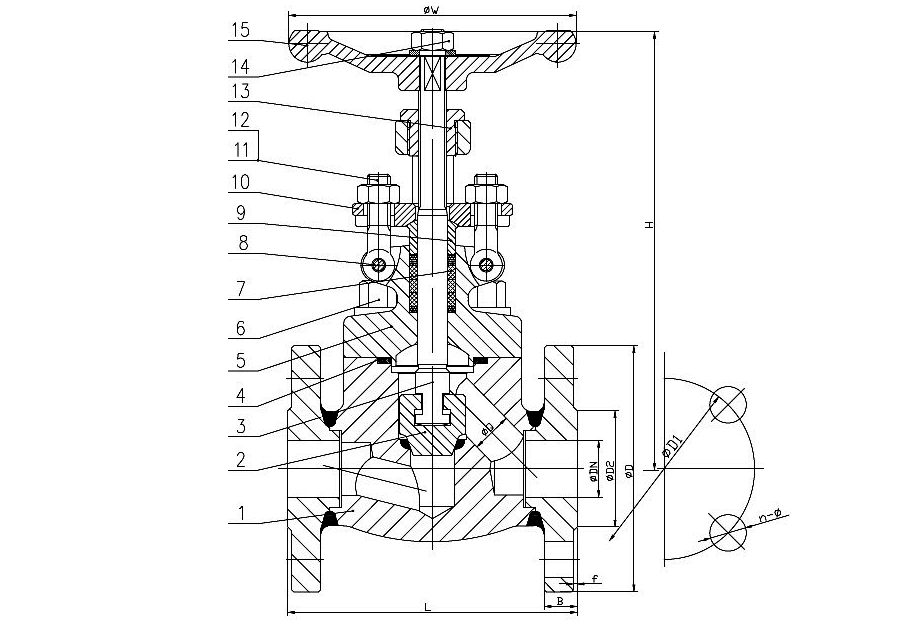
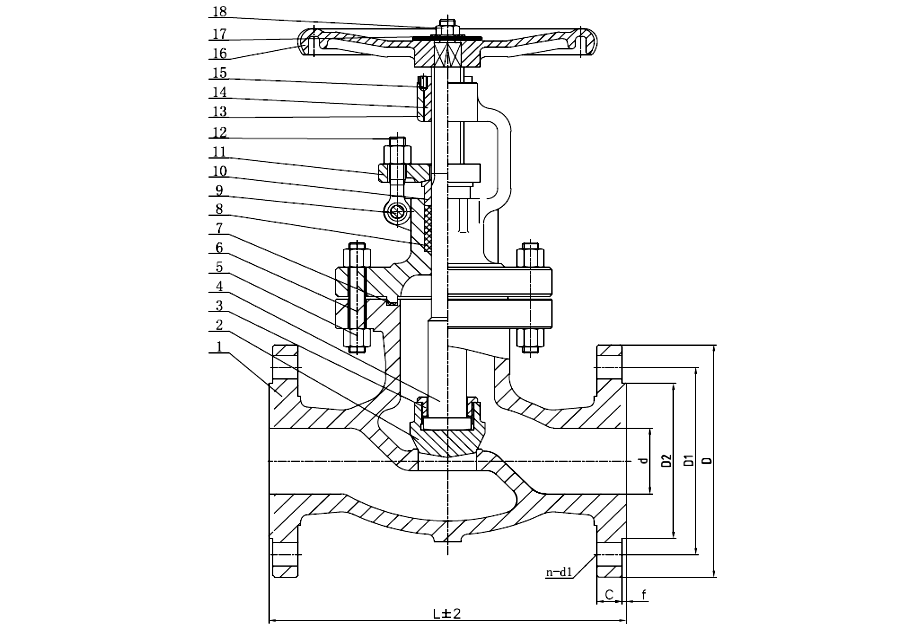
- The item numbers are the manufacturer’s. They are the callout numbers from the sectional drawing, which is why a number can repeat a part name at a different position. We have left them exactly as published so a spares order matches the drawing.
- The seating surfaces are what wear. On a valve that runs part open, flow through the gap is fast, and the disc face and seat take that. They are the parts to ask about first.
- Everything here is published, not on request. If you need to know what touches your fluid, the whole list is above.
Sizes and dimensions
7 sizes. Dimensions in millimetres.
The dimension that decides whether the valve fits is face‑to‑face L — the gap it needs in the pipe run. A globe valve is longer face to face than a gate valve of the same size, so it is not a drop‑in replacement for one. Letters follow the manufacturer’s drawing; where a letter is ambiguous we have left it as published rather than guess.
1" to 1½" (DN25 to DN40) — forged F316
| Size | Part no | Bore Q | Flange OD D | Bolt circle D1 | Raised face D2 | Face‑to‑face L | Handwheel W | Height H | Flange thk B | RF height F | Bolts n‑z |
|---|---|---|---|---|---|---|---|---|---|---|---|
| 1" | VL-S-GL-F-150-16 | 18 | 108 | 79 | 51 | 127 | 125 | 203 | 14 | 1.3 | 4- 16 |
| 1 1/4" | VL-S-GL-F-150-20 | 23 | 117 | 89 | 63.5 | 140 | 160 | 224 | 16 | 1.3 | 4- 16 |
| 1 1/2" | VL-S-GL-F-150-24 | 30 | 127 | 98.5 | 75 | 165 | 160 | 260 | 17.5 | 1.3 | 4- 16 |
2" to 4" (DN50 to DN100) — cast CF8M
| Size | Part no | Bore d | Flange OD D | Bolt circle D1 | Raised face D2 | Flange thk C | RF height f | Face‑to‑face L | Bolts n‑d1 |
|---|---|---|---|---|---|---|---|---|---|
| 2" | VL-S-GL-F-150-32 | 51 | 152 | 120.7 | 92.1 | 14.3 | 2 | 203 | 4- 19 |
| 2 1/2" | VL-S-GL-F-150-40 | 65 | 180 | 139.7 | 104.8 | 15.9 | 2 | 216 | 4- 19 |
| 3" | VL-S-GL-F-150-48 | 76 | 190 | 152.4 | 127 | 17.5 | 2 | 241 | 4- 19 |
| 4" | VL-S-GL-F-150-64 | 102 | 230 | 190.5 | 157.2 | 22.3 | 2 | 292 | 8- 19 |
- ⚠ Measure the gap in the run against face‑to‑face L. On a replacement, measure the valve coming out rather than trusting a drawing — and if you are replacing a gate valve, expect the globe valve to be longer.
- Leave headroom for the stem. The stem rises as the valve opens, so the closed height is not the open height. Height H where published is the closed figure.
- Leave room to turn the handwheel. Handwheel W is its diameter, and a globe valve takes many turns rather than a quarter turn. Send us the space you have if it is tight.
- Support the weight. A valve must not hang on the pipework, and on the larger sizes here that matters.
Test pressures and temperature
Factory proof tests. Not working pressures.
1" to 1½" (DN25 to DN40) — forged F316
| Normal Pressure | 150 PSI |
| Shell Test Pressure | 3.0 MPa |
| Seal Test | 2.2 MPa |
| Gas-Tightness Test | 0.6 MPa |
| Max Working Pressure | -20&°;C to 425&°;C |
2" to 4" (DN50 to DN100) — cast CF8M
| Normal Pressure | 150 PSI |
| Shell Test Pressure | 3.0 MPa |
| Seal Test | 2.2 MPa |
| Back Seal Test | 2.2 MPa |
| Gas-Tightness Test | 0.6 MPa |
| Max Working Pressure | 425&°;C |
- ⚠ Do not design to these figures. They are manufacturing proof tests well above the working rating — the shell test proves the body, the seal test proves the disc against its seat. The valve is not intended to operate there.
- Gas tightness is 0.6 MPa, the same figure across all ten variants in this range. It is the one number that does not move with class, size or material.
- The temperature ceiling is the material, not a seat insert. A globe valve seals metal to metal and packs the stem with graphite, which is why the steel variants here reach 425 °C where a PTFE‑seated ball valve stops at 150. All ten compared.
Fitting and operating it
Four things that decide whether it works.
- Flow under the seat, normally. Line pressure then helps lift the disc, the packing sits out of the throttling stream, and the valve opens against less force. Check the arrow on the body and fit it that way round — a globe valve fitted backwards still works, but it throttles worse and wears its packing faster.
- It is allowed to sit part open. That is what it is for. Set the position with the handwheel and leave it. Unlike a gate valve, nothing is being damaged by running in between.
- Expect pressure drop even fully open. The flow path turns twice. If you need a straight‑through path and only ever want on or off, a gate valve or a ball valve is the right tool.
- Do not close it with a bar. A globe valve seals with the disc pressed onto its seat, and the handwheel gives you enough leverage already. Over‑tightening deforms the seating faces, and on this valve the seat is part of the body on the forged variants — there is nothing to replace.
- Re‑tighten the gland if the stem weeps. A little and evenly. Graphite packing takes some adjustment; a leaking stem left alone will cut the stem itself.
Not sure this is the right one?
Duty first, then end connection, then material.
Choose this one when
- You need to set and hold a flow, not just open and shut.
- Your pipework takes ANSI 150# flange ends — checked, not assumed.
- Working pressure is within 150 PSI and temperature within −20 °C to 425 °C as published on the small band, 425 °C on the large.
- The duty suits Stainless steel — A182 F316 forged, A351 CF8M cast.
- Your specification names API 602 and BS 5352 or API 598.
Choose something else when
- You only ever want fully open or fully shut with least pressure drop → gate valves or ball valves.
- You need a quarter turn you can operate in a second → ball valves.
- Your end connection is different → the other nine variants. Nothing here adapts across end types.
- You need higher pressure → high pressure valves, or needle valves for fine control at pressure.
- You need to stop reverse flow rather than control forward flow → check valves.
- The bore is large and the pressure low → butterfly valves.
All ten, side by side: the comparison table. Other variants: ANSI 150 cast iron · ANSI 150 cast steel · ANSI 150 forged steel · JIS 10K cast iron · JIS 10K SS316 · Threaded forged steel · Threaded SS316 200 PSI · Threaded SS316 800 PSI · Weld end forged steel.
Questions we get asked
The ones that come up on the phone.
What is the ANSI 150 SS316 globe valve?
A rising‑stem globe valve for throttling and isolation, 1" to 4" (DN25 to DN100), with ANSI 150# flange ends and a body in Stainless steel — A182 F316 forged, A351 CF8M cast. Rated 150 PSI for service at −20 °C to 425 °C as published on the small band, 425 °C on the large. Designed and manufactured to API 602 and BS 5352, inspected and tested to API 598. Shell tested at 3.0 MPa.
What is a globe valve for, and why not use a gate valve?
A globe valve is built to run part open. Flow turns up through a seat opening, past a disc that lifts squarely off the seat, and turns down again — so the gap changes smoothly with stem position and a flow can be set and held. A gate valve must not be parked part open: the gate sits in the stream, vibrates, and cuts its own seat. Use a globe valve to set a flow, a gate valve or a ball valve to go fully open or fully shut with the least pressure drop.
Can I use it to replace a gate valve of the same size?
Usually not without changing the pipework. A globe valve is longer face to face than a gate valve at the same size — at 2" in cast steel it is 203 mm against 178. It also drops more pressure when fully open. Measure the gap in your run against the face‑to‑face figures before ordering, and if the answer is that only a gate valve fits, we stock ten of those too.
Which way round does it go in?
Normally flow under the seat, so line pressure helps lift the disc and the packing sits out of the throttling stream. Check the arrow cast or stamped on the body and follow it. Fitted the other way it still works, but it throttles less well and wears the gland faster.
What temperature can it run at?
The published figure is −20 °C to 425 °C as published on the small band, 425 °C on the large. A globe valve seals metal to metal and packs the stem with graphite, so the body material sets the ceiling rather than a polymer seat — which is why the steel variants in this range reach 425 °C against 150 °C for a PTFE‑seated ball valve. Several variants publish figures that do not line up with each other; we set all ten out and flag every one.
What is it made of?
The body is Stainless steel — A182 F316 forged, A351 CF8M cast and the trim is F316 disc, stem, gland and pin. The full numbered parts list is on this page, with the manufacturer’s own item numbers so a spares order matches the drawing.
What are the test pressures?
3.0 MPa shell or body test, 2.2 MPa seal test, and 0.6 MPa gas tightness. Those are factory proof tests, not working pressures — do not design to them. Gas tightness is 0.6 MPa on all ten variants in this range. The figures.
Will it fit my pipework?
It has ANSI 150# flange ends, and end dimensions to ASME B16.5. That has to match what you have — and on a flanged valve the pressure rating does not answer the question, because ANSI 150 and JIS 10K are rated similarly and drilled differently. Send us the end type and size, or a photo of the mating flange, and we will confirm. All ten end types compared.
How many turns to open it?
Many — a globe valve is not a quarter‑turn valve. The stem rises as it opens, so the handwheel position tells you the disc position, which is what makes it usable for setting a flow. Travel is shorter than a gate valve of the same size, because the disc only has to clear the seat rather than rise clear of the whole bore.
What sizes do you hold in stock?
1" to 4" (DN25 to DN100), held in Malaysia or Singapore. Send the size and the end connection and we will confirm availability and a landed price — transport, currency, duties and taxes already inside the figure. The full dimension table is above.
Catalogue
Direct PDF download — no form, no email address.

Send the size and the end connection
We will confirm the ANSI 150# flange ends match your pipework, check the face‑to‑face against the gap in your run, and quote a landed price. Stock in Malaysia and Singapore.