
Home › Products › Low pressure valves › Flange end ball valves › ANSI 300 cast steel
ANSI 300# API 608ANSI 300 cast steel flange end ball valve, 1 1/2" to 6"
A flanged quarter‑turn ball valve with ANSI 300# flanges, 1 1/2" to 6" (DN40 to DN150), in Cast carbon steel ASTM A216 WCB. Designed and manufactured to API 608, flange ends to Wall thickness to ASME B16.34. Shell tested at 7.8 MPa, for service at 100 °C.
The ANSI 300 cast steel flange end ball valve
Built to API 608, with ANSI 300# flanges.
A quarter‑turn ball valve that bolts into the line through ANSI 300# flanges, in 1 1/2" to 6" (DN40 to DN150). The body is Cast carbon steel ASTM A216 WCB and it is designed and manufactured to API 608, with face‑to‑face dimensions to ASME B16.10 and flange ends to Wall thickness to ASME B16.34.
On a flanged valve the standard is not paperwork — it is the dimensions. The ANSI 300# drilling has to match the flange it bolts to, and the face‑to‑face length has to match the gap in the pipe run. Both are in the size table. The other three flange standards we stock will not bolt to this one. All six compared.
- ⚠ This is not a stainless valve. The body and body connector are ASTM A216 WCB cast carbon steel, and the ball is ASTM A240 304 with an ASTM A182 F304 stem — 304, not 316. Corrosion resistance is well below the SS316 variants. The part‑by‑part comparison.
- Graphite, not PTFE, on the packing. Flexible graphite packing and an SS304 + graphite gasket take more heat and handle thermal cycling better than the PTFE used on the stainless variants. On hot, clean, non‑corrosive duty that is a genuine advantage.
- An anti‑static device is fitted. Item 24, in SS304. A ball turning on PTFE seats is electrically isolated from the body; this bonds it back. It matters on hydrocarbons, and the stainless variants here do not list one.
- Alloy‑steel pressure bolting. A193 B7 studs with A194 2H nuts — stronger than the SS304 fasteners on the stainless variants, though less corrosion‑resistant.
- Rated to 100 °C, as the catalogue states. If you need Class 300 at 150 °C, use the ANSI 300 SS316, which states the full range — or ask us to confirm this variant’s figure with the factory.
- Tested at 7.8 MPa shell, 5.6 MPa seat and 0.6 MPa gas tightness, for service at 100 °C. Those are factory proof tests, not working pressures — do not design to them. The figures.
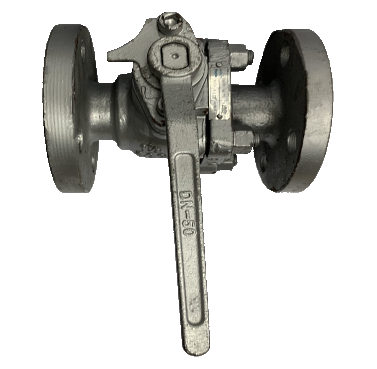
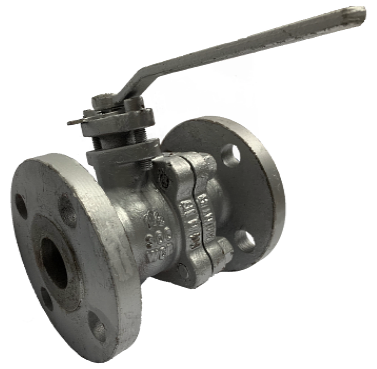
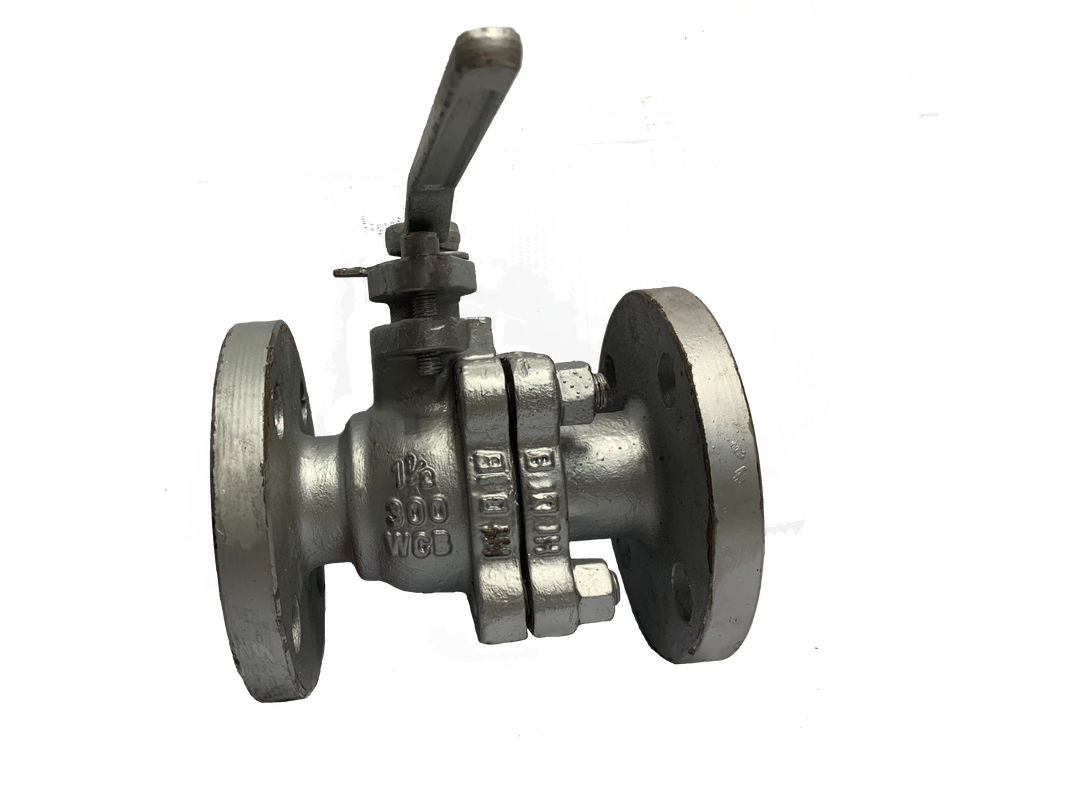
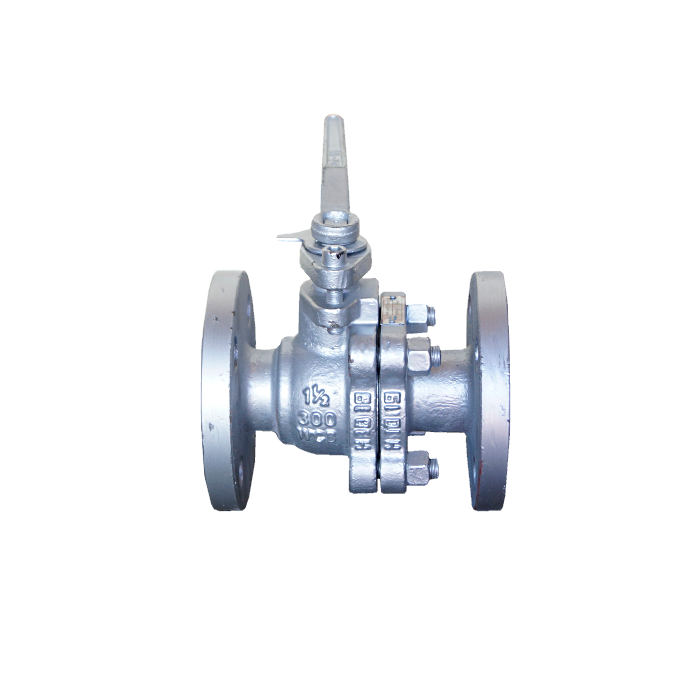
Four angles on the same valve. All photographs of the stocked item, not renders.
Specification
Everything that goes on a purchase order.
| Size range | 1 1/2" to 6" (DN40 to DN150) |
| Flange standard | ANSI 300# — not interchangeable with ANSI, JIS or PN alternatives |
| Design and manufacture | API 608 |
| Face‑to‑face dimensions | ASME B16.10 |
| Flange ends | Wall thickness to ASME B16.34 |
| Body material | Cast carbon steel ASTM A216 WCB |
| Trim | ASTM A240 304 ball, A182 F304 stem |
| Seat | PTFE — which sets the temperature ceiling |
| Shell test pressure | 7.8 MPa |
| Seat test pressure | 5.6 MPa |
| Gas tightness test | 0.6 MPa |
| Maximum working temperature | 100 °C |
| Operation | Quarter turn manual lever |
| Stock | Held in Malaysia or Singapore |
Bill of materials
All 16 parts and what each is made of, with the manufacturer’s own item numbers.
| No | Part name | Material |
|---|---|---|
| 1 | Body | ASTM A216 WCB |
| 2 | Body Connector | ASTM A216 WCB |
| 3 | Ball | ASTM A240 304 |
| 6 | Stem | ASTM A182 F304 |
| 10 | Packing Gland | ASTM A216 WCB |
| 13 | Seat | PTFE |
| 17a | Gasket | SS304 + graphite |
| 18 | Packing | Flexible graphite |
| 19a | Bolts | ASTM A193 B7 |
| 19c | Screw | ASTM A193 B7 |
| 20a | Nuts | ASTM A194 2H |
| 23 | Thrust Washer | PTFE |
| 24 | Anti-static Device | SS304 |
| 26 | Lever | ASTM A216 WCB + Zn |
| 31 | Stopper | ASTM A29 1025 + Zn |
| 32 | Ring | ASTM A29 1566 |
The manufacturer’s sectional drawing. The callout numbers correspond to the part numbers in the table above.
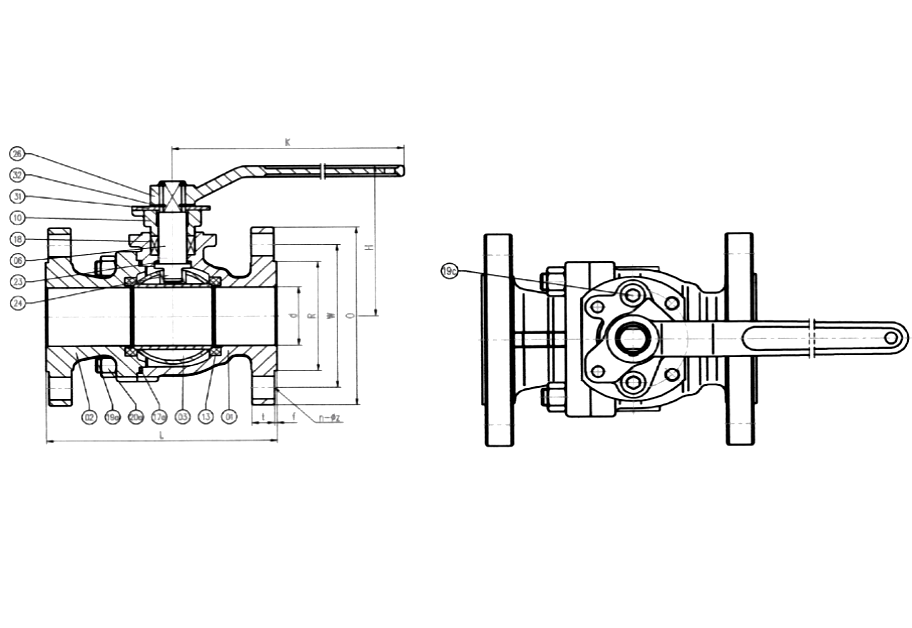
- The item numbers are the manufacturer’s, not a 1–16 list. They are the callout numbers from the sectional drawing, which is why they skip and why some carry letters. We have left them exactly as published so a spares order matches the drawing.
- The PTFE seat sets the temperature ceiling, not the body. That is why this valve tops out at 100 °C whatever the body is made of.
- Everything here is published, not on request. If you need to know what touches your fluid, the whole list is above.
Sizes and dimensions
6 sizes. Dimensions in millimetres.
The two figures that decide whether the valve fits are face‑to‑face L — the gap it needs in the pipe run — and the bolt circle with its hole pattern, which has to match the mating flange. Letters follow the manufacturer’s drawing; where a letter is ambiguous we have left it as published rather than guess at it.
| Size | Part no | DN | Face‑to‑face L | Bore d | O | Handle W | R | Bolts n‑z | f | t | Height H | K | Weight (kg) |
|---|---|---|---|---|---|---|---|---|---|---|---|---|---|
| 1 1/2" | VL-CS-B2-F-300-24 | 40 | 190 | 40 | 155 | 116 | 77 | 4- 22 | 2 | 20 | 130 | 195 | 10.60 |
| 2" | VL-CS-B2-F-300-32 | 50 | 216 | 50 | 165 | 128 | 98 | 4- 19 | 2 | 20.5 | 140 | 235 | 13.68 |
| 2 1/2" | VL-CS-B2-F-300-40 | 65 | 241 | 65 | 191 | 150 | 110 | 8- 22 | 2 | 23 | 165 | 255 | 19.90 |
| 3" | VL-CS-B2-F-300-48 | 80 | 282 | 78 | 210 | 168 | 133 | 8- 22 | 2 | 27 | 185 | 275 | 30.40 |
| 4" | VL-CS-B2-F-300-64 | 100 | 305 | 100 | 255 | 200 | 165 | 8- 22 | 2 | 30 | 195 | 520 | 48.50 |
| 6" | VL-CS-B2-F-300-96 | 150 | 403 | 150 | 320 | 272 | 222 | 12- 22 | 2 | 36.5 | 260 | 775 | 99.20 |
- ⚠ Check the bolt circle before you order. It is the one dimension that cannot be worked around. ANSI 300# will not bolt to any of the other three standards we stock, whatever the pressure rating says. The comparison.
- Measure the gap in the run against face‑to‑face L, especially on a replacement — and measure the valve coming out rather than trusting a drawing.
- Leave clearance for the lever. It needs a clear 90° sweep and on the larger sizes it is long. Send us the space you have if it is tight.
- Support the weight. These are not light at the top of the range, and a flanged valve must not hang on the pipework.
Test pressures and temperature
Factory proof tests. Not working pressures.
| Normal Pressure | Class 300 |
| Body Test Pressure | 7.8 MPa |
| Seat Test Pressure | 5.6 MPa |
| Hermetical Sealing Test | 0.6 MPa |
| Max Working Temperature | 100&°;C |
- ⚠ Do not design to these figures. They are manufacturing proof tests well above the working rating — the shell test proves the casting, the seat test proves the seal, and the gas test proves it holds low‑pressure gas. The valve is not intended to operate there.
- Gas tightness is 0.6 MPa across the whole range — the one figure that does not change with class or material.
- The temperature limit is the PTFE seat. Cast carbon steel ASTM A216 WCB would take far more; the seat is what stops it. All six variants compared.
Not sure this is the right one?
Flange standard first, then material.
Choose this one when
- Your pipework is ANSI 300# — checked, not assumed.
- Your specification names API 608, ASME B16.10 or Wall thickness to ASME B16.34.
- The duty suits Cast carbon steel ASTM A216 WCB.
- Service is within 100 °C.
Choose something else when
- Your pipework is a different flange standard → pick by flange. Nothing here bolts across standards.
- The fluid or environment is corrosive → an SS316 variant. Cast steel is carbon steel with 304 trim.
- You need threaded or weld ends, or a size below 1/2" → ball valves, 1/8" to 4".
- You need to throttle rather than isolate → globe valves.
- You need higher pressure → high pressure ball valves.
All six, side by side: the comparison table. Other variants: ANSI 150 SS316 · ANSI 150 cast steel · ANSI 300 SS316 · JIS 10K SS316 · PN10/16 SS316.
Questions we get asked
The ones that come up on the phone.
What is the ANSI 300 cast steel flange end ball valve?
A quarter‑turn ball valve with ANSI 300# flanges, 1 1/2" to 6" (DN40 to DN150), in Cast carbon steel ASTM A216 WCB. It is designed and manufactured to API 608, with face‑to‑face dimensions to ASME B16.10 and flange ends to Wall thickness to ASME B16.34. Tested at 7.8 MPa shell and 0.6 MPa gas tightness, for service at 100 °C.
Will it bolt to my pipework?
Only if your pipework is ANSI 300#. That is the whole question on a flanged valve, and it is not answered by the pressure rating — ANSI 150, JIS 10K and PN10/16 are all rated around 1.6 to 2 MPa and none of them bolts to another, because the bolt circles differ. Count the bolt holes and measure the bolt circle on the mating flange, or send us a photo. All four standards.
What standard is it built to?
API 608 for design and manufacture, ASME B16.10 for face‑to‑face dimensions, and Wall thickness to ASME B16.34 for the flange ends. If your specification names one of those, it names this valve. The other five variants in this range are built to different standards. The full stack.
What is it made of?
Body and body connector in ASTM A216 WCB cast carbon steel, with an ASTM A240 304 ball and ASTM A182 F304 stem. Note that is 304, not 316, and the body is carbon steel — this is not a stainless valve. Seat in PTFE, packing in flexible graphite, gasket in SS304 and graphite, bolting in A193 B7 with A194 2H nuts, plus an SS304 anti‑static device. The full numbered list is on this page.
What temperature can it run at?
The published figure for this variant is 100 °C, and it is worth knowing that every other flange end variant we stock states −29 °C to 150 °C. If you need Class 300 at 150 °C, ask us to confirm before ordering, or use the ANSI 300 SS316, which states the full range.
What are the shell and seat test pressures?
7.8 MPa shell, 5.6 MPa seat and 0.6 MPa gas tightness. These are factory proof tests, not working pressures — do not design to them. Gas tightness is 0.6 MPa on all six variants; the shell figure roughly doubles between Class 150 and Class 300. The table.
Which dimension decides whether it drops into my pipe run?
Face‑to‑face L — the length between the two flange faces. Measure the gap in the run, and on a replacement measure the valve you are taking out rather than trusting a drawing. You also need the bolt circle and hole pattern to match. Both are in the size table.
Do you supply threaded ball valves instead?
Yes — eight threaded and weld‑end variants from 1/8" to 4", including one, two and three‑piece bodies, three‑way L‑port and T‑port, brass, and two mini ranges. Threaded suits smaller sizes and permanent installations; flanged suits larger sizes and anything you expect to remove for service.
What sizes do you hold in stock?
1 1/2" to 6" (DN40 to DN150), held in Malaysia or Singapore. Send the size and the flange standard and we will confirm availability and a landed price — transport, currency, duties and taxes already inside the figure. The full dimension table is above.
Catalogue
Direct PDF download — no form, no email address.
Send the flange standard and the size
We will confirm the ANSI 300# drilling matches your pipework, check the face‑to‑face against the gap in your run, and quote a landed price. Stock in Malaysia and Singapore.