
Home › Products › Low pressure valves › Y‑strainers › JIS 10K SS316
JIS 10K flange - JIS 10KJIS 10K SS316 Y‑strainer, 1½" to 4"
A Y‑strainer in 1½" to 4" (DN40 to DN100) with JIS 10K flange ends, a body in SS316 with A351 CF8M cast stainless and a removable screen. Rated JIS 10K to −20 °C to 230 °C as published. No moving parts — it protects, it does not isolate.
The JIS 10K SS316 Y‑strainer
JIS 10K flange ends, SS316 with A351 CF8M cast stainless.
A Y‑strainer in 1½" to 4" (DN40 to DN100), with JIS 10K flange ends and a body in SS316 with A351 CF8M cast stainless. The screen is SS316, 1 mm mesh as standard. Rated JIS 10K for service at −20 °C to 230 °C as published.
It is a tee with a screen in the leg. Flow passes through a mesh element angled down into the branch, anything larger than the opening stays behind, and a cap at the bottom lets you flush it out or lift the screen for cleaning. There are no moving parts and it does not shut anything off — it exists to keep debris out of the pumps, valves, meters and regulators downstream, all of which cost more than it does.
- The flange dimensions here are genuinely JIS. Flange outside diameters of 140, 155, 175, 185 and 210 mm at 1½" to 4" match JIS 10K for 40A to 100A. That is worth stating plainly, because it makes this the complete and reliable dimension table in the Y‑strainer range — the JIS cast steel version has none at all, and elsewhere on this site a gate valve and a globe valve both publish “JIS” tables that are really ANSI.
- ⚠ JIS 10K will not bolt to ANSI 150. Both sit near 1.6 to 2 MPa, which is what makes this an expensive mistake rather than an obvious one. Check the bolt circle on the mating flange, not the pressure rating.
- Rated to −20 °C, as published. A small difference from the cast steel variants’ −29 that only matters on genuinely cold duty.
- 230 °C, against 150 °C for the cast steel strainers on the same PTFE gasket. If your duty sits between the two, use a stainless variant.
- The screen is 1 mm, which is exactly 18 mesh — the coarse end of the range, right for construction debris. Screens are a separate order; tell us the mesh. The chart.
- Identical weights to the ANSI version, 4.60 to 24.00 kg. Same casting, different flange drilling.
- It protects, it does not isolate. Fit a gate valve or a ball valve either side so the screen can be cleaned without draining the line, and a gauge either side so you know when to. Why the gauges matter.
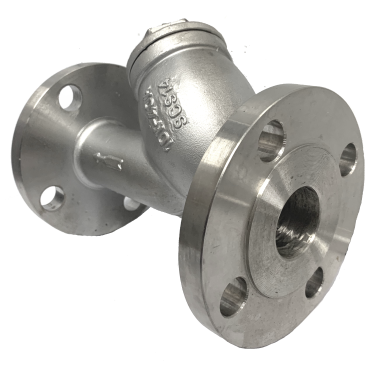
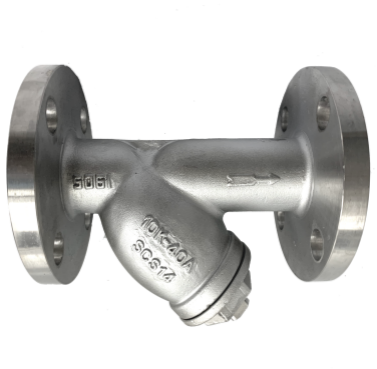
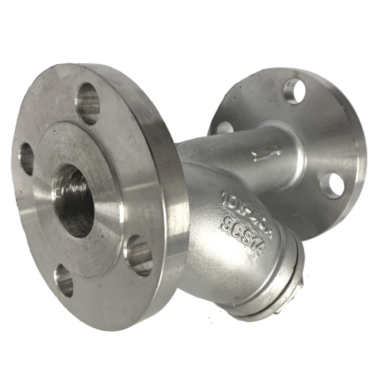
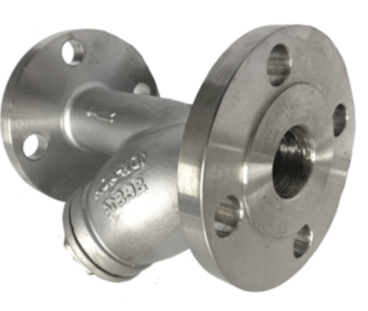
Four angles on the same strainer. Photographs of the stocked item, not renders.
Specification
Everything that goes on a purchase order.
| Size range | 1½" to 4" (DN40 to DN100) |
| End connection | JIS 10K flange |
| Working pressure | JIS 10K |
| Working temperature | −20 °C to 230 °C as published |
| Body and cover | SS316 with A351 CF8M cast stainless |
| Screen | SS316, 1 mm mesh as standard |
| Gasket | PTFE |
| Shell test | 3.0 MPa |
| Moving parts | None. A strainer does not open, close or throttle |
| Parts in the list | 7 |
| Orientation | Cap pointing downward, flow following the arrow cast into the body — see fitting |
| Cleaning | Flush through the bottom cap, or lift the self‑aligning screen out through the cover |
| Catalogue | The manufacturer’s PDF for this variant |
| Stock | Held in Malaysia or Singapore |
Bill of materials
All 7 parts. There is not much to a strainer, which is the point.
| No | Part name | Material |
|---|---|---|
| 1 | Body | SS316 and CF8M |
| 2 | Strainer Screen | SS316 1mm Mesh |
| 3 | Bolt | SS304 |
| 4 | Gasket | PTFE |
| 5 | Bonnet | SS316 and CF8M |
| 6 | Nut | SS304 |
| 7 | Bolt | SS304 |
The manufacturer’s sectional drawing. The callout numbers correspond to the item numbers in the parts list.
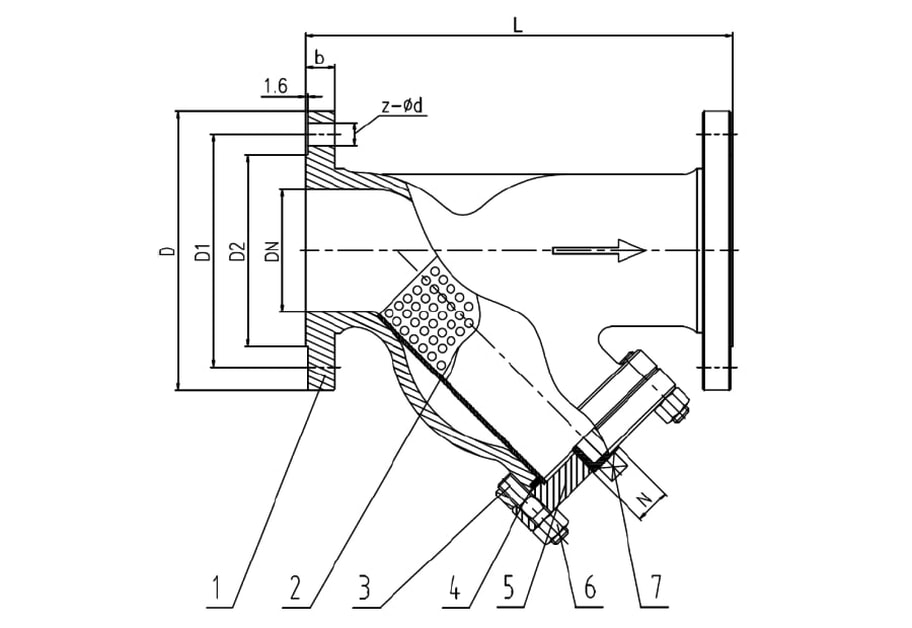
- The screen is the only wear part. Everything else is a casting or a fastener. It is the part to keep a spare of, and the part to ask us about first.
- The item numbers are the manufacturer’s, matching the callouts on the drawing above, so a spares order matches the section.
- PTFE on the gasket — the same on all five variants in this range, which is what makes the temperature differences between them hard to explain.
- Everything here is published, not on request. If you need to know what touches your fluid, the whole list is above.
Sizes and dimensions
5 sizes. Dimensions in millimetres, weights in kilogrammes.
The dimension that decides whether it fits is the end‑to‑end length L — the gap it needs in the pipe run. On a flanged strainer you also need the bolt circle and hole pattern to match the mating flange. And leave clearance below the strainer: the screen comes out downward through the cover, and on the larger sizes that is not a small allowance.
| Size | Connection | IMPA | Part no | Flange OD D | Bolt circle D1 | Raised face D2 | Length L | Flange thk b | Plug N | Weight (kg) |
|---|---|---|---|---|---|---|---|---|---|---|
| 1 1/2" | Flange-end | – | VL-S-YS-F-10K-24 | 140 | 105 | 81 | 200 | 16 | 1/2" | 4.60 |
| 2" | Flange-end | – | VL-S-YS-F-10K-32 | 155 | 120 | 96 | 220 | 16 | 1/2" | 6.30 |
| 2 1/2" | Flange-end | – | VL-S-YS-F-10K-40 | 175 | 140 | 116 | 250 | 18 | 1/2" | 10.50 |
| 3" | Flange-end | – | VL-S-YS-F-10K-48 | 185 | 150 | 126 | 280 | 18 | 3/4" | 14.50 |
| 4" | Flange-end | – | VL-S-YS-F-10K-64 | 210 | 175 | 151 | 300 | 18 | 3/4" | 24.00 |
- ⚠ Leave room under it, not just around it. A strainer you cannot get the screen out of is a strainer nobody cleans, and a screen nobody cleans eventually tears.
- Measure the gap in the run against L. On a replacement, measure the unit coming out rather than trusting a drawing.
- Support the weight. A strainer must not hang on the pipework, and it must never be used to pull a misaligned flange together.
- Letters follow the manufacturer’s drawing. Where a letter is ambiguous we have left it as published rather than guess at it.
Test pressure and temperature
As published. Where a field is blank, we say so.
| Normal Pressure | JIS 10K |
| Shell Test Pressure | 3.0 MPa |
| Tightness Test | - |
| Gas-Tightness Test | - |
| Max Working Pressure | -20&°;C to 230&°;C |
- ⚠ A shell test is a proof test, not a working pressure. Where 3.0 MPa is published it is roughly twice the nominal rating and exists to prove the casting. Do not design to it.
- ⚠ Pressure rating is not what limits a strainer in service. Differential pressure across a blocking screen is what collapses an element, and that happens far below the shell rating. It is the real failure mode, and it gives no warning. Watch the differential.
- The five variants carry different ratings. The stainless strainers are rated to 230 °C and the cast steel ones to 150 °C, both on a PTFE gasket. All five side by side.
Not sure this is the right one?
End connection first, then material, then mesh.
Choose this one when
- Your pipework takes JIS 10K flange ends — checked, not assumed.
- Working pressure is within JIS 10K and temperature within −20 °C to 230 °C as published.
- The duty suits SS316 with A351 CF8M cast stainless.
- Your size falls in 1½" to 4".
Choose something else when
- Your end connection is different → the other four variants. Nothing here adapts across end types.
- The duty is clean and non‑corrosive and cost matters → a cast steel variant.
- You need a size below 1", or more than 150# → threaded SS316, 1/4" to 4" at 800 PSI.
- You need to isolate rather than strain → gate valves or ball valves.
- You need to stop reverse flow → check valves.
All five, side by side: the comparison table. Other variants: ANSI 150 SS316 · ANSI 150 cast steel · JIS 10K cast steel · Threaded SS316.
Questions we get asked
The ones that come up on the phone.
What is the JIS 10K SS316 Y‑strainer?
A Y‑strainer in 1½" to 4" (DN40 to DN100) with JIS 10K flange ends, a body in SS316 with A351 CF8M cast stainless and a screen in SS316, 1 mm mesh as standard. Rated JIS 10K for service at −20 °C to 230 °C as published. It is a tee with a screen in the leg — no moving parts, and it does not isolate.
What is it for?
Keeping pipeline debris out of the equipment behind it. Weld spatter, pipe scale, rust, thread cuttings and jointing compound all travel with the flow and all arrive at whatever is narrowest downstream — a globe valve seat, a control valve trim, a flow meter, a pump impeller. Every one of those costs more than the strainer and takes longer to replace. What it is protecting, item by item.
Which mesh should I order?
Work back from the smallest clearance you are protecting and choose a screen finer than that — then do not go finer than you need, because every step finer raises pressure drop and shortens the interval between cleanings. This variant ships with a 1 mm SS316 screen as standard, which is exactly 18 mesh — the coarse end of the range, right for construction debris rather than fine filtration. The full chart, 10 mesh to 120.
Does a higher mesh number mean finer or coarser?
Finer. Mesh number counts openings across one linear inch, so more openings in the same inch means smaller openings: 10 mesh passes 2000 microns, 120 mesh passes 125.
Which way up does it go?
Cap pointing downward, so gravity holds the debris in the leg instead of letting it fall back into the flow every time the system stops. Flow follows the arrow cast into the body. On a vertical run, flow must be downward. And leave clearance below it, because the screen comes out downward through the cover. The full five‑step procedure.
How often will it need cleaning?
There is no fixed interval and anyone who gives you one is guessing — it depends entirely on how dirty your fluid is. Fit a pressure gauge either side and record the drop when the screen is clean; that baseline is what every later reading is judged against. Expect to check often in the first weeks of a new system, when the pipework is shedding its own construction debris. How to monitor it.
What is it made of?
Body and cover in SS316 with A351 CF8M cast stainless, screen in SS316, 1 mm mesh as standard, gasket in PTFE. Everything in the pressure boundary is stainless. The full numbered list is on this page.
Will it fit my pipework?
It has JIS 10K flange ends. On a flanged strainer the pressure rating does not answer that question — ANSI 150 and JIS 10K are rated similarly and drilled differently, so check the bolt circle on the mating flange. At 2" the JIS flange is 155 mm across against 152 mm for ANSI: close enough to look interchangeable. Send the size and end type, or a photo, and we will confirm. All five compared.
What are the test pressures?
The published shell test is 3.0 MPa, roughly twice the JIS 10K nominal rating. That is a proof test, not a working pressure — do not design to it. And note that what actually destroys a strainer in service is differential pressure across a blocked screen, which happens far below the shell figure.
Do you supply spare screens?
Yes — the screen is the only wear part on the whole assembly and we stock them. Send the size, the variant and the mesh you want. Keeping one on the shelf is the difference between a clean and a shutdown, because a torn screen filters nothing and gives no sign that it has stopped.
What sizes do you hold in stock?
1½" to 4" (DN40 to DN100), held in Malaysia or Singapore. Send the size, the end connection and the mesh and we will confirm availability and a landed price — transport, currency, duties and taxes already inside the figure.
Catalogue
Direct PDF download — no form, no email address.
Send the size, the end connection and the mesh
We will confirm the JIS 10K flange ends match your pipework, recommend a mesh for what you are protecting, and quote a landed price with a spare screen. Stock in Malaysia and Singapore.