
Home › Products › Low pressure valves › Ball valves › SS316 mini
Down to 1/8" · stainless · 1000 PSISS316 mini ball valve, male × female, 1/8" to 1"
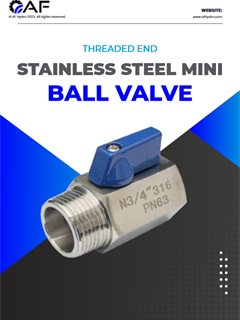
A compact SS316 quarter‑turn valve for gauge, drain and instrument isolation. 1000 PSI, and the only variant on this range that goes down to 1/8" (DN6). Threaded BSPP or NPT, for −29 °C to 150 °C.
What a mini ball valve is for
Small isolation, where a full‑size valve will not fit.
A mini ball valve does the same quarter‑turn job as the full‑size valves on this range, in a much smaller body. It is a male × female pattern, which means it screws directly into a female port and presents a female thread on the other side — so it drops straight into a gauge tapping, a drain point, a sample point or an instrument line without an adaptor.
It is the only source of 1/8" (DN6) anywhere on this range — every other variant starts at 1/4". If you need to isolate a small instrument tapping, this is the valve.
- 1000 PSI from a compact body — the same rating as the full‑size stainless valves, in a fraction of the space. Against the brass mini at 300 PSI, that is more than three times the pressure for the same footprint.
- ⚠ The stem is SS304, not SS316. The body, ball and cap are SS316, but the stem and bolt are SS304 and the lever is aluminium. It is a lighter‑duty build than the full‑size stainless valves despite carrying the same 1000 PSI — and there is no anti‑static device. Worth knowing on aggressive or hydrocarbon service.
- Male × female saves a fitting. The male end goes into the existing port and the female end takes the gauge or the tube fitting. On a crowded manifold, not needing an extra nipple is often the reason this valve gets specified.
- Reduced bore, and that is the point. These are isolation valves for instrument and drain duty, not flow devices. Bore figures are in the table.
- Leave room for the lever. It still needs a clear 90° sweep, and on a small valve in a tight cluster that is easy to overlook. Check the width and length columns before ordering.
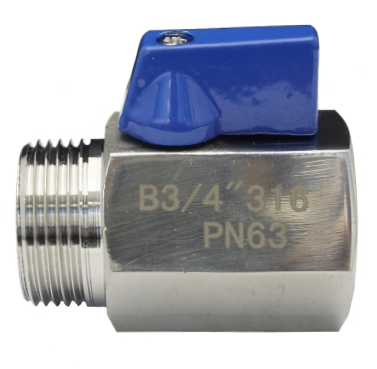
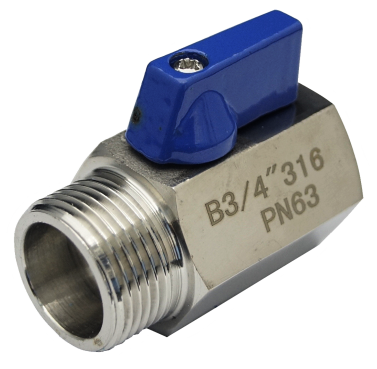
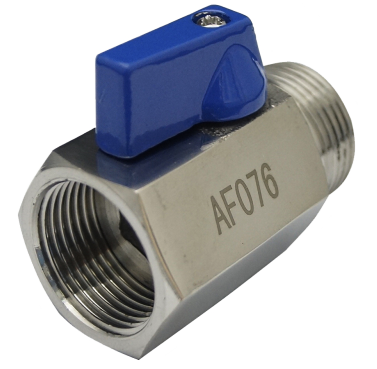
Specification
Everything that goes on a purchase order.
| Size range | 1/8" to 1" (DN6 to DN25) |
| Pattern | Male × female — threads into a female port, presents a female thread |
| Body material | Stainless steel SS316 |
| Working pressure | 1000 PSI cold — derate for temperature |
| Working temperature | −29 °C to 150 °C |
| Connection type | BSPP or NPT |
| Bore | Reduced bore — an isolation valve, not a flow device |
| Seat | PTFE |
| Operation | Quarter turn manual lever |
| Typical duty | Gauge tappings, drain and sample points, instrument isolation |
| Stock | Held in Malaysia or Singapore |
Bill of materials and sectional drawing
All 7 parts and what each is made of.
| No | Part name | Material |
|---|---|---|
| 1 | Body | SS316 and CF8M |
| 2 | Ball | SS316 |
| 3 | Cap | SS316 |
| 4 | Ball Seat | PTFE |
| 5 | Stem | SS304 |
| 6 | Bolt | SS304 |
| 7 | Lever | Aluminium |
The manufacturer’s sectional drawing. The callout numbers correspond to the part numbers in the table above.
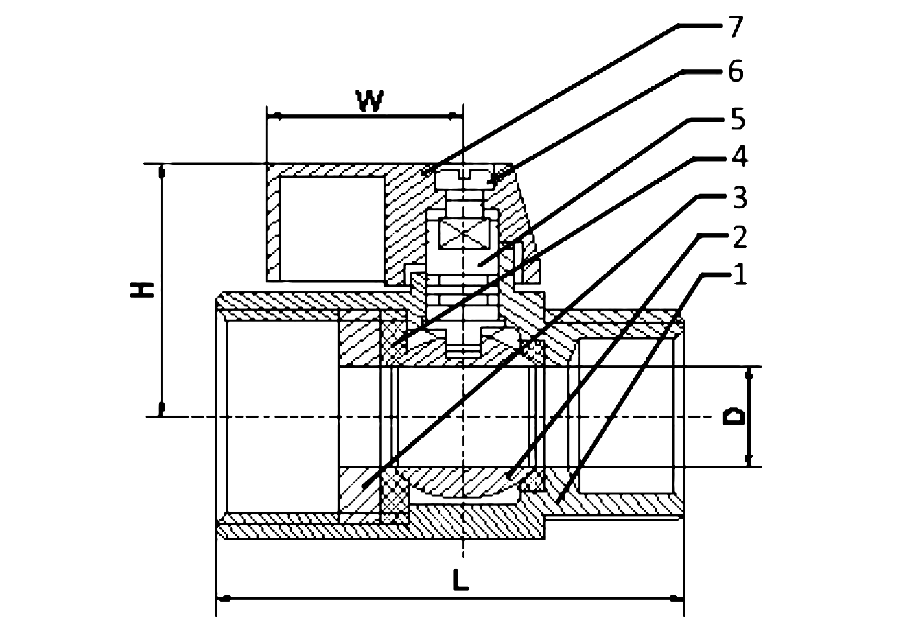
- ⚠ The stem is SS304, not SS316. The body, ball and cap are SS316, but the stem and bolt are SS304 and the lever is aluminium. It is a lighter‑duty build than the full‑size stainless valves despite carrying the same 1000 PSI — and there is no anti‑static device. Worth knowing on aggressive or hydrocarbon service.
- The seat is PTFE, which is what sets the 150 °C ceiling and why the pressure rating falls as the line warms. The derating curve.
- 7 parts is a simple valve. The full‑size stainless two‑piece lists thirteen. Fewer parts in a smaller body — which is why it fits, and why it does less.
- The lever is aluminium. Lighter and cheaper than a stainless lever, and outside the pressure boundary — but it is the part most likely to be knocked or corroded on an exposed installation.
Sizes and dimensions
6 sizes. Dimensions in millimetres.
Check the width and length against the space you have — on a crowded gauge manifold these are the dimensions that decide whether the valve fits, and the lever still needs a clear 90° sweep.
| Size | Bore D | Height H | Width W | Length L | Weight (kg) |
|---|---|---|---|---|---|
| 1/8" | 7 | 26.5 | 22.9 | 40 | 0.081 |
| 1/4" | 7 | 26.5 | 22.9 | 40 | 0.081 |
| 3/8" | 7 | 26.5 | 22.9 | 40 | 0.084 |
| 1/2" | 9.2 | 29.3 | 22.9 | 46 | 0.105 |
| 3/4" | 12.5 | 31.5 | 22.9 | 54 | 0.105 |
| 1" | 15 | 34 | 22.9 | 65 | 0.284 |
- The bore is well under the thread size. These are isolation valves — sized to shut off a small line reliably, not to pass maximum flow. If you need flow, use a full‑size full‑bore valve.
- Several sizes share a body. Where the dimensions repeat across adjacent sizes, the valves are machined from the same blank with a different thread — so the physical envelope does not change even though the connection does.
- Weight is negligible compared to the pipework, so these can generally be carried on the tubing — but a gauge hanging off one is a different matter, and that wants supporting.
Not sure this is the right one?
A mini valve is chosen on space first, then pressure.
Choose this one when
- You are isolating a gauge, drain, sample or instrument point.
- Space is the constraint and a full‑size body will not fit.
- You want to avoid an extra nipple or adaptor — male × female does it in one part.
- The duty is within 1000 PSI and the thread form is BSPP or NPT.
Choose something else when
- You need 300 PSI or a different material in the same footprint → brass mini ball valve.
- Flow matters → a full‑bore two‑piece.
- You need larger than 1" → two‑piece or brass, both to 4".
- You need to divert or mix → L‑port or T‑port.
- Service must happen without a line shutdown → three‑piece.
All eight, side by side: the comparison table. Other variants: 1‑piece · 2‑piece · 3‑piece · L‑port · T‑port · Brass · Brass mini.
Questions we get asked
The ones that come up on the phone.
What is a mini ball valve used for?
Small isolation where a full‑size valve will not fit — gauge tappings, drain and sample points, and instrument lines. It is a male × female pattern, so it threads directly into an existing female port and presents a female thread for the gauge or tube fitting, saving an adaptor on a crowded manifold.
What does male x female mean?
One end has a male thread and the other a female thread. The male end screws into the port you are isolating; the female end receives the gauge, the tube fitting or the next component. It means you can add isolation to an existing tapping without adding a nipple.
What pressure does it take?
1000 PSI cold. That is the same rating as the full‑size stainless valves, in a much smaller body — and more than three times the brass mini at 300 PSI. Both figures derate as the line warms: about 67% at 150 °C. The curve.
What thread forms is it available in?
BSPP or NPT. They are not interchangeable with each other — a mismatched pair engages and feels tight, then leaks. If you are unsure which is on the existing tapping, send a photo before ordering. The brass mini, by contrast, is BSPP only.
What is the smallest size you can supply?
1/8" (DN6), and this is the only variant on the whole range that offers it — every other ball valve here starts at 1/4". If you need to isolate a small instrument tapping, this is the valve.
What are the internal parts made of?
SS316 body, ball and cap, with a PTFE ball seat. Note the stem and bolt are SS304 rather than SS316, and the lever is aluminium — a lighter build than the full‑size stainless valves despite the same 1000 PSI, and with no anti‑static device. Full list on this page.
Is it full bore?
No — reduced bore, and deliberately so. A mini valve exists to shut off a small line in a small space, not to pass maximum flow. The bore figures are in the size table. If flow matters, use a full‑size full‑bore two‑piece.
Which mini should I choose, brass or stainless?
Pressure and environment decide it. The brass mini is 300 PSI; this one is 1000 PSI. Choose SS316 for higher pressure, corrosive or marine service, or where you need NPT; choose brass for water and air at modest pressure where cost rules. The brass mini · all eight compared.
Catalogue
Direct PDF download — no form, no email address.
Related: brass mini ball valve · all ball valves · class 150 threaded fittings · all low pressure valves.
Send the thread size and what it has to isolate
We will confirm the thread form, check the envelope against your space, and quote a landed price. Stock in Malaysia and Singapore.