
Home › Products › Low pressure valves › Spring check valves
1/4" to 2" · 1000 PSI · BSPP or NPTSpring check valves, 1/4" to 2"
The check valve that does not care which way up it is — a spring closes it, not gravity. SS316 body and disc, inline poppet, 1000 PSI: more than three times any other check valve we stock at this size.
Get a quotation within 2 working hours
Send the part number, standard, size or quantity. Stock in Malaysia or Singapore, ISO 9001:2015 certified.
How a spring check valve works
A poppet in a barrel, held shut by a spring.
A spring check valve is an inline poppet. Forward flow pushes a disc back along the axis of the valve against a spring; when flow falls away, the spring pushes the disc back onto its seat before reverse flow has properly started. Everything happens inside a smooth barrel with a screwed‑in cap — there is no bonnet, no hinge and nothing on the outside that moves.
Two things follow from that, and they are the whole reason to choose this valve over a swing check. First, gravity is not part of the mechanism, so the valve works in any orientation — including a vertical run with flow downward, where a swing check simply will not close. Second, because the spring starts closing it as flow decays rather than waiting for reversal, it closes earlier and more gently, which means far less slam.
- It works upside down, sideways, or vertically downward. That is the headline. A swing check needs the bonnet up on a horizontal run and upward flow on a vertical one; this one has no such rule.
- ⚠ The spring costs you pressure. Forward flow has to push the disc open against it every time, so there is a cracking pressure to overcome and a permanent drop while running. On a gravity feed or a very low‑head system that can matter — tell us the available head.
- 1000 PSI, which is the point at these sizes. Against 200 PSI for the threaded SS316 swing check and 300 PSI for the brass one. If your small‑bore line is anywhere near those figures, this is the valve.
- Nothing on the outside moves. No bonnet to weep, no hinge pin to wear, no cap to work loose. It is the most compact and the most sealed of the check valves we stock.
- ⚠ It still fails silently. Debris on the seat holds the poppet fractionally open and the valve passes reverse flow while looking perfectly normal — exactly as a swing check does. Fit a Y‑strainer upstream.
- ⚠ Very little is published for this range. There is a four‑part bill of materials, a size range, a pressure and two thread forms. There is no dimension table, no weight, no test pressure and no working temperature. We say so plainly below rather than fill the gaps in. What is and is not published.
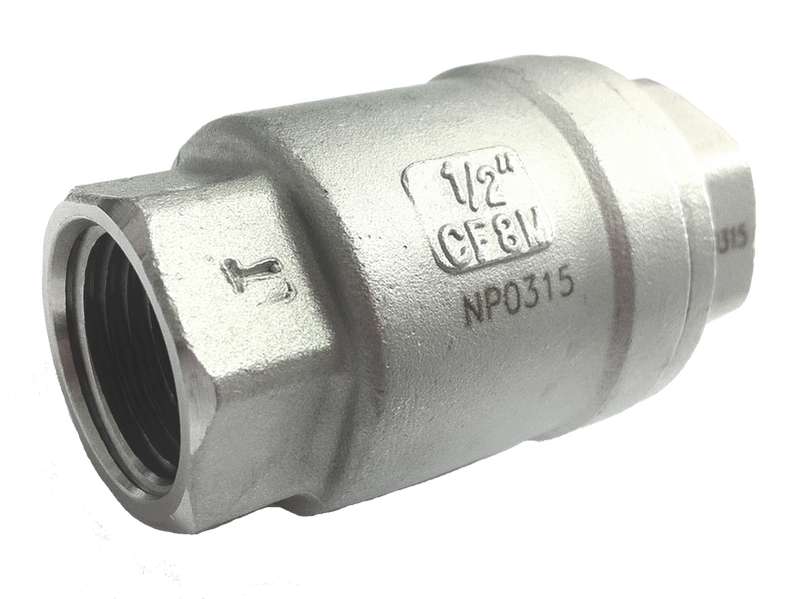
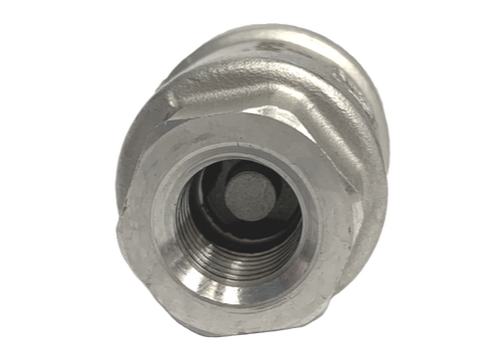
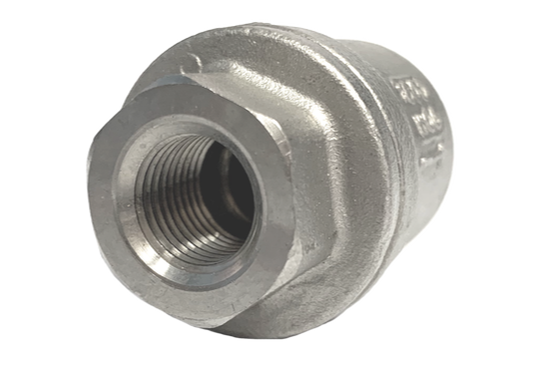
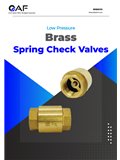
Photographs of the stocked item, not renders.
Why orientation stops mattering
The one thing that decides between this and a swing check.
A swing check valve closes because its disc falls. That is why it has three orientation rules — flow along the cast arrow, bonnet up on a horizontal run, flow upward on a vertical one — and why it cannot be used on downward flow at all. Take gravity away and the disc has nothing closing it.
A spring check has a spring doing that job. Gravity is irrelevant to it, so the valve can be fitted in any attitude the pipework happens to present. The only rule left is the one every check valve has: flow must follow the arrow.
| Installation | Spring check | Swing check |
|---|---|---|
| Horizontal run, cap up | Yes | Yes — the only correct way |
| Horizontal run, any rotation | Yes | No — the disc must close with gravity |
| Vertical run, flow upward | Yes | Yes |
| Vertical run, flow downward | Yes | No — gravity holds it open |
| Angled or awkward pipework | Yes | Only if the hinge pin ends up horizontal |
| Closes on | Spring force, as flow decays | Gravity and backpressure, after flow reverses |
| Slam | Much less — it is already closing | More — it stops a moving column |
| Pressure drop open | Higher — the spring resists flow | Lower — the disc lifts clear of the bore |
- Downward flow is the clearest case. If your line runs vertically and the fluid goes down it, a swing check is not an option at any price. This is the valve.
- Slam is the second case. The spring starts closing the poppet as forward flow falls off rather than waiting for reversal, so there is far less moving column to stop. On a long line or a high‑head pump that matters. In larger sizes the same argument points at a dual plate check valve.
- Pressure is the third. 1000 PSI against 200 or 300 for the threaded swing checks. At 1/4" to 2" there is nothing else in this range close to it.
- ⚠ The cost is cracking pressure. Forward flow must open the valve against the spring, every time. On a pumped line that is nothing; on a gravity feed, a vent or a low‑head drain it can be the difference between working and not. Tell us the available head and we will check it.
- Flow still follows the arrow. Orientation stops mattering; direction never does. Fitted backwards, any check valve blocks the line.
What is published, and what is not
This range has the thinnest datasheet of anything we stock. Here is exactly how thin.
Most product pages on this site are an exercise in reading a dense datasheet carefully. This one is the opposite. The manufacturer publishes a four‑part bill of materials, a size range, a pressure and two thread forms — and that is all. Rather than pad the gap with plausible figures, we have set out both columns.
Published
- Size range — 1/4" to 2" (DN8 to DN50).
- Working pressure — 1000 PSI.
- End connections — BSPP or NPT, female both ends.
- Materials, all four parts: body SS316 and CF8M, spring SS316, disc SS316 and CF8M, cap SS316 and CF8M.
- A sectional drawing, and photographs of the stocked item.
- A brass variant exists too — there are separate catalogue PDFs for the stainless and brass ranges, though the specification on this page describes the stainless one.
⚠ Not published
- No dimension table at all. No length, no height, no hex size — nothing to check against the gap in your run. Every other threaded valve in this range publishes all three.
- No weights.
- No test pressures. No shell test, no seal test, no gas test.
- No working temperature. The body is stainless and the spring is stainless, with no elastomer listed at all — which suggests a metal‑to‑metal seat and therefore a wide range. But that is an inference and we will not print it as a figure.
- No cracking pressure, which on a spring check is the figure you most want. Ask us and we will get it.
- No part numbers. Order by size and thread form, and we will confirm the code.
- Two materials are offered: stainless and brass. The specification reads “Stainless Steel SS316 Brass”; the parts list on this page is the stainless one (all four parts SS316 or CF8M), and a separate brass catalogue covers the brass range. Tell us which material you want and we quote the right one.
- Ask us for anything on the right‑hand list. We will measure a stocked valve for dimensions, and get test pressures, temperature and cracking pressure from the factory. That is a same‑day answer, and it is better than a number we made up.
- What we can say with confidence is the left‑hand list, plus what the photographs show: an inline poppet body, a screwed‑in cap, a cast flow arrow, a heat number on the casting, and no external moving parts.
Bill of materials
Four parts. It is the simplest valve on this site.
| No | Part name | Material |
|---|---|---|
| 1 | Body | SS316, CF8M |
| 2 | Spring | SS316 |
| 3 | Disc | SS316, CF8M |
| 4 | Cap | SS316, CF8M |
- Four parts, and no elastomer anywhere. No gasket, no O‑ring, no soft seat is listed. That points to a metal‑to‑metal seat, which would explain both the 1000 PSI rating and the absence of a temperature limit — there is no rubber to set one. We have asked the factory to confirm it rather than state it here as fact.
- The spring is SS316, like everything else. Worth noting, because a carbon or 302 spring in a stainless body is a common and unwelcome shortcut — it is the part sitting in the fluid doing all the work.
- Everything wetted is 316. Body, disc, spring and cap. There are no lower‑grade fasteners in this valve because there are no fasteners — the cap screws directly into the body.
- The spring and the seat are what wear. A spring that has taken millions of cycles gets weaker, and a weak spring closes late. If a spring check has been in service a long time and the line is now knocking, that is the first thing to suspect.
- ⚠ Compare a swing check, which has eight or nine parts including a hinge, a pin, a gasket and bolting. Fewer parts is fewer things to fail — and also fewer things to replace, since a spring check is generally changed rather than repaired.
Spring check valves — the specification
As published. Blanks are marked, not filled.
| Size range | 1/4" to 2" (DN8 to DN50) |
| End connections | BSPP or NPT, female both ends |
| Working pressure | 1000 PSI — the highest of any check valve we stock at this size |
| Body | SS316 / CF8M |
| Disc | SS316 / CF8M |
| Spring | SS316 |
| Cap | SS316 / CF8M, screwed into the body |
| Seat | Not separately listed — no elastomer appears anywhere in the parts list |
| Orientation | Any, including vertical with flow downward — the reason to choose this valve |
| Flow direction | Follow the arrow cast into the body. This is the one rule that still applies |
| Moving parts | Two — the disc and the spring. Nothing moves outside the body |
| ⚠ Dimensions | Not published. We measure a stocked valve on request |
| ⚠ Weight | Not published |
| ⚠ Test pressures | Not published |
| ⚠ Working temperature | Not published |
| ⚠ Cracking pressure | Not published — and on a spring check it is the figure that decides whether it suits a low‑head line |
| Catalogues | Spring check valves PDF · brass spring check valves PDF |
| Fit upstream | A Y‑strainer. A spring check fails silently just as a swing check does |
| Stock | Held in Malaysia or Singapore |
Six kinds of check valve
All six are on this site. The spring type wins on orientation and pressure.
| Type | Closes on | Orientation | Sizes | Right when |
|---|---|---|---|---|
| Spring check | A spring, as flow decays | Any, including flow downward | 1/4"–2" | Awkward orientation, high pressure, or slam matters. 1000 PSI at these sizes. |
| Swing check | Gravity and backpressure, after reversal | Bonnet up, or flow upward. Never downward | 1/4"–6" | The general case — lowest pressure drop and the widest size range. |
| Dual plate check | Two spring‑loaded half discs | Any | 1½"–6" | Short runs and less slam, in the larger flanged sizes. |
| Single plate check | One spring‑loaded disc on a hinge | Any | 1½"–6" | The same short‑body case, lighter and cheaper than dual plate. |
| SAE flange check | Spring‑loaded poppet | Any | SAE flanged | You are on SAE flanged hydraulic pipework. |
| High pressure check | Spring‑loaded poppet or ball | Any | Small bore | Pressure is well beyond 1000 PSI. |
- Everything except the swing check is spring‑loaded, and everything spring‑loaded works in any orientation. If your pipework will not let you fit a valve the right way up, the swing check is the only one of the six that is ruled out.
- Below 2", spring is the high‑pressure answer. 1000 PSI against 200 or 300 for the threaded swing checks.
- Above 2", the wafer types take over. A dual plate or single plate valve fits between two flanges and gives the same any‑orientation, low‑slam behaviour in the larger sizes.
- None of them isolates. A check valve stops reverse flow only. You still need a gate valve or a ball valve to shut the line deliberately.
Why buy them from us
Stock, a landed price, and a straight answer about what is missing.
What you get
- Stock in Malaysia and Singapore, in both thread forms.
- A landed price — transport, currency, duties and taxes already inside the figure.
- Measurements taken off a real valve where the datasheet has none — which on this range is most of it.
- All six kinds of check valve from one supplier, so if a spring check is the wrong answer we can say so and still supply the right one.
- Both catalogue PDFs, stainless and brass.
How we treat the data
- We list what is missing. Six things are not published for this range, including the dimensions and the cracking pressure. They are set out in a column of their own rather than quietly skipped.
- We do not infer a temperature from an absence. No elastomer is listed, which suggests a metal seat and a wide range — and we have gone and asked rather than print the inference.
- We flag the brass ambiguity rather than let you assume this page covers both materials. The specification box and the parts list disagree.
- We measure rather than estimate. Ask for a length or a hex size and you get one off a stocked valve, same day.
- We never invent a number. If it is not published, this site says it is not published.
Questions we get asked
The ones that come up on the phone.
What is a spring check valve?
An inline poppet held shut by a spring. Forward flow pushes a disc back along the axis of the valve against the spring; when flow falls away the spring pushes it back onto its seat. It all happens inside a smooth barrel with a screwed‑in cap — no bonnet, no hinge, nothing moving on the outside. Ours are SS316 and CF8M throughout, 1/4" to 2", rated 1000 PSI, in BSPP or NPT.
Can I fit it upside down, or on a downward flow?
Yes to both. A spring closes this valve, so gravity is not part of the mechanism and orientation stops mattering. That is the main reason to choose it over a swing check valve, which needs the bonnet up on a horizontal run, needs upward flow on a vertical one, and cannot be used on downward flow at all. The one rule that still applies is direction: flow must follow the arrow cast into the body. The full comparison.
Spring or swing — which should I use?
Spring if the orientation is awkward, if the flow runs downward, if the pressure is high, or if slam is a concern — the spring starts closing the poppet as flow decays rather than waiting for reversal, so there is far less moving column to stop. Swing if you want the lowest possible pressure drop, because its disc lifts clear of the bore while a spring permanently resists flow, or if you need a size above 2". All six kinds compared.
What is the cracking pressure?
Not published, and it is the figure we get asked for most. Forward flow has to push the poppet open against the spring every time, so there is a minimum pressure below which the valve simply will not open. On a pumped line that is irrelevant; on a gravity feed, a vent or a low‑head drain it can decide whether the system works. Tell us the available head and we will get the figure from the factory before you order.
What temperature can it take?
Not published. What we can tell you is that the four‑part list contains no elastomer at all — no gasket, no O‑ring, no soft seat — which points to a metal‑to‑metal seat and therefore a wide range. But that is an inference, not a figure, and we will not print it as one. Ask us and we will confirm it with the factory.
How long is it? I need to check it fits.
There is no published dimension table for this range — no length, no height, no hex size. Every other threaded valve we stock publishes all three, and this one publishes none. Tell us the size and thread form and we will measure a stocked valve, same day. That is a better answer than an estimate.
Is it stainless or brass?
The page you are reading describes the stainless valve — all four listed parts are SS316 or CF8M. But the specification box reads “Stainless Steel SS316 Brass”, and a separate brass catalogue covers the brass range; the parts list on this page is the stainless one. Tell us which material you want and we will quote the right one.
Does it need a strainer in front of it?
Yes, for the same reason every check valve does. Debris on the seat holds the poppet fractionally open, and the valve then passes reverse flow while looking perfectly normal from outside — there is nothing to inspect and no indicator to read. A Y‑strainer upstream costs a fraction of what it protects.
BSPP or NPT?
Both are offered, and they are not interchangeable. BSPP is a 55° parallel thread that seals on a washer or a bonded seal at the face; NPT is a 60° taper that seals on the thread flanks with sealant or tape. Forcing one into the other damages both and does not seal. State which one your pipework is when you order.
What sizes do you hold in stock?
1/4" to 2" (DN8 to DN50) in BSPP and NPT, held in Malaysia or Singapore. Send the size, the thread form, the fluid and the available head if the line is not pumped — that last one is what decides whether a spring check suits the duty. We will confirm availability and a landed price.
Catalogues
Direct PDF downloads — no form, no email address.
Send the size, the thread and the head
If the line is not pumped, tell us the available head — a spring check has to be opened against its spring, and that is the figure the datasheet does not give. We will get it from the factory, measure a stocked valve for dimensions, and quote a landed price. Stock in Malaysia and Singapore.