
Home › Products › Pipe clamps › Tubeclo tube clamps
DIN 3015 · exclusive to usDIN 3015 pipe & tube clamps, 6 mm to 406 mm — Tubeclo
Tubeclo tube clamps to DIN 3015 — standard, heavy and twin. Bodies in polypropylene, polyamide and aluminium, from −40 °C to +300 °C, with plates and bolts in galvanized or stainless steel. They stack and stagger, so a bank of lines takes the least space the run allows. Tubeclo is the line we stock most deeply in Malaysia — it is ours exclusively, so we carry the odd groups as well as the popular ones.
What a Tubeclo tube clamp is
A square body with a ribbed bore, built to DIN 3015.
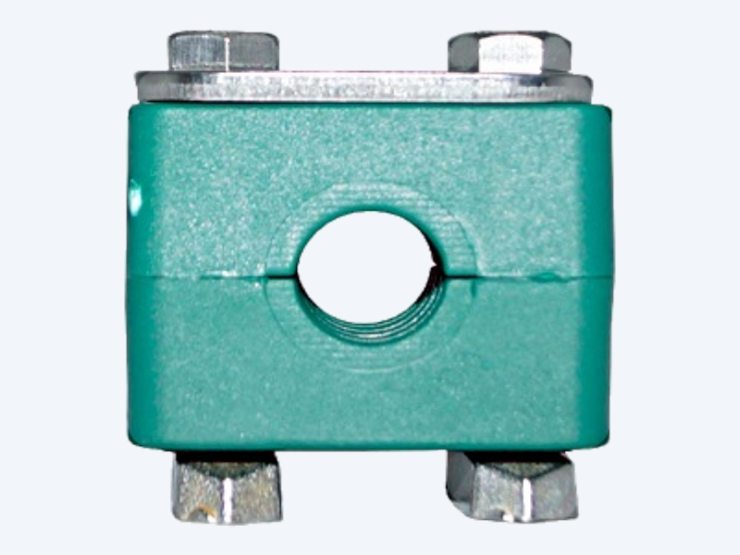
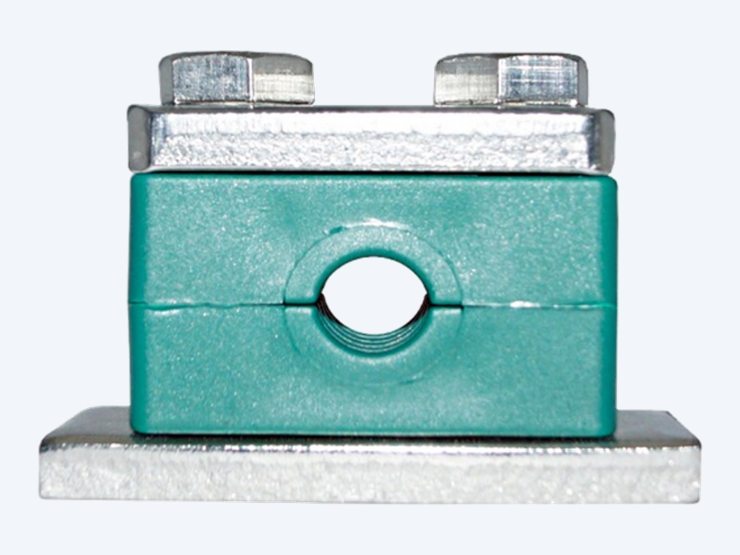
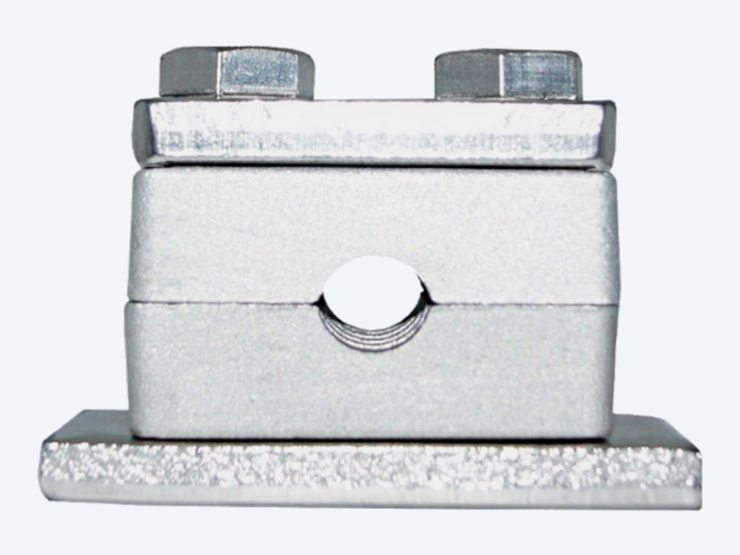
A Tubeclo tube clamp holds a tube, pipe, hose or cable along a run and takes the mechanical shock and vibration out of it before that energy reaches a fitting or a weld. The body is a square plastic block split into two identical halves, and the bore is ribbed — the ribs grip the line and deaden sound rather than pinching the tube.
Everything is built to DIN 3015: part 1 is the standard series, part 2 the heavy series, part 3 the twin series. That is why plates, rails and bolts from different batches still fit together, and why the published load figures are comparable between makers.
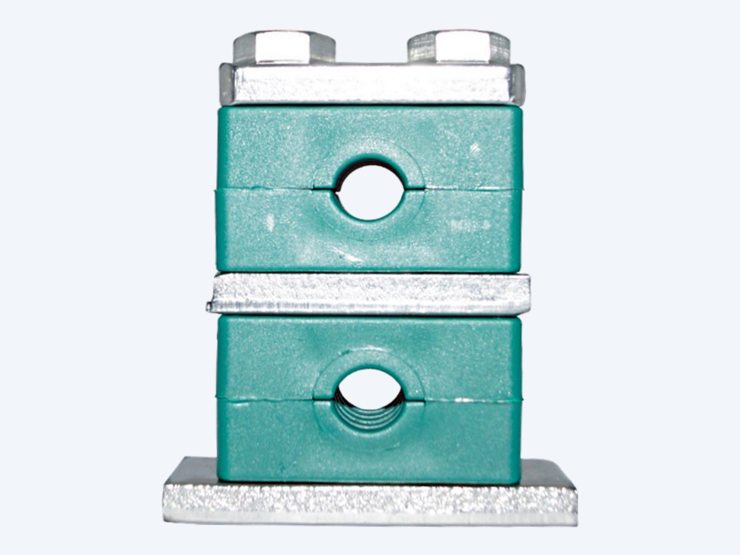
- It stacks and staggers. Identical bodies mount directly on top of one another with stacking bolts and safety locking plates, so a bank of lines takes the least space the run allows. How that goes together.
- Two halves, a plate and bolts. Undo the bolts and the line lifts out — which is why clamps get specified where a run has to be serviced, not just supported.
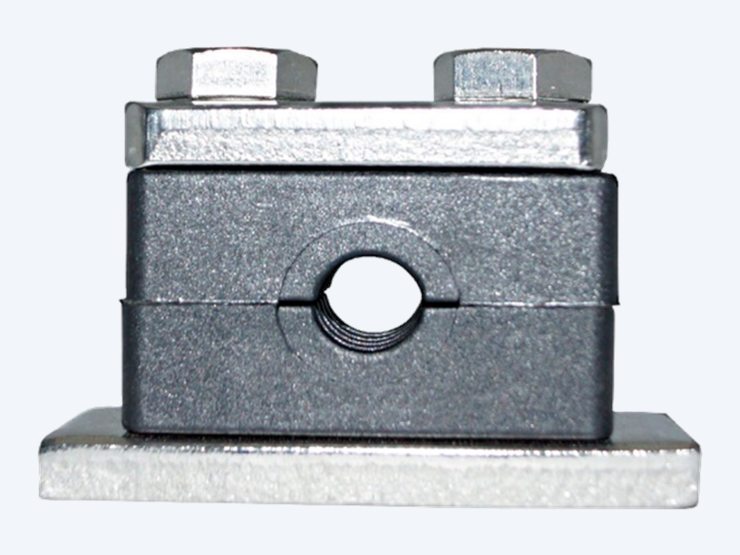
- The body material sets the temperature, and it is colour coded: green, black or silver. The five body codes.
- Also called pipe clamps, tube clamps and hydraulic brackets. Same product. Tubeclo is a line we hold exclusively.
Tubeclo tube clamps — the specification
Everything that goes on a purchase order, in one table.
| Standard | DIN 3015 — part 1 standard, part 2 heavy, part 3 twin |
| Standard series | 6 mm to 102 mm outside diameter (to 4"), groups 1, 1A, 2–8 |
| Heavy series | 6 mm to 406 mm outside diameter (to 16"), groups 3S–12S |
| Twin series | 6 mm to 42 mm outside diameter, two lines per clamp, groups 1D–5D |
| Body materials | PP polypropylene · PA polyamide · ALU aluminium — plus the smooth‑bore PPH and PAH |
| Body temperature | PP −30 to +90 °C · PA −40 to +120 °C · ALU to +300 °C |
| Bore | Ribbed (profile inside), with tension clearance on PP, PA and ALU. Smooth, without tension clearance on PPH and PAH |
| Accessory materials | Carbon steel ST37 · stainless A2 (AISI 304/303) · stainless A4 (AISI 316/316Ti) — codes W1 to W5 |
| Metal parts on order | C carbon steel or SS stainless SS316 — the last field of the part number |
| Bolt sizes | M6 across every standard group · M10 to M30 on heavy · M6 and M8 on twin — by group |
| Maximum load | From 0.6 kN on a group 1 PP clamp to 244.5 kN on a group 12S aluminium — full tables |
| Mounting | Weld plate · elongated (bolted) weld plate · mounting rail with rail nuts · channel rail adaptor · group weld plate · stacked |
| Stock | Held in Johor Bahru and Singapore. Tubeclo is a line we carry exclusively, so we hold it deeper |
Two numbers do the real work. The group, which follows from the tube outside diameter and fixes both the bolt size and the load — and the spacing along the run, which decides how many clamps you actually buy. Get those right and the rest of the code writes itself.
The three series, the three body materials, and the stacking that makes Tubeclo compact.
Buying Tubeclo clamps in Malaysia and Singapore
What we need from you, and what you get back.
Five things and we can quote
- The tube or pipe outside diameter in mm, not the nominal bore. The group follows from it.
- The run length, so we quote a clamp count rather than one clamp.
- The duty — load and vibration decide standard against heavy, and which body.
- The environment, which decides C carbon steel or SS stainless SS316.
- How it mounts — weld plate, bolted plate, rail, or stacked. The three methods.
What comes back
- A landed price — transport, currency, duties and taxes already inside the figure.
- The full part number for every line, field by field, so it can be re‑ordered without asking us.
- Stock in Johor Bahru and Singapore, and under three working days on a stocked item.
- Parts as line items, not just complete sets — so adding to an existing rail costs what it should.
Aluminium bodies, SS316 metal parts and the made‑to‑order accessories come in to order, and we quote that lead time with the price.
Standard, heavy or twin?
Load and vibration pick the series. Size only narrows it.
All three are DIN 3015 and all three work the same way. What separates them is how much load and vibration the body will carry — and the size ranges follow from that, because a bigger pipe means a bigger load.
| Series | Groups | Size range | Bodies | Typical duty |
|---|---|---|---|---|
| Standard DIN 3015‑1 | 1, 1A, 2–8 | 6–102 mm to 4" | PP · PA · ALU | Average load, moderate vibration — mobile equipment, machine tools, instrumentation |
| Heavy DIN 3015‑2 | 3S–12S | 6–406 mm to 16" | PP · PA · ALU | Higher load and vibration — mining, metal plant, heavy industrial |
| Twin DIN 3015‑3 | 1D–5D | 6–42 mm two lines | PP · PA | Two lines running together, moderate vibration — general industrial |
- The series overlap heavily at the small end. A 20 mm line can be clamped as standard group 3, heavy group 4S or twin group 3D — three different parts, three prices, three load ratings. Tell us the duty, not just the size.
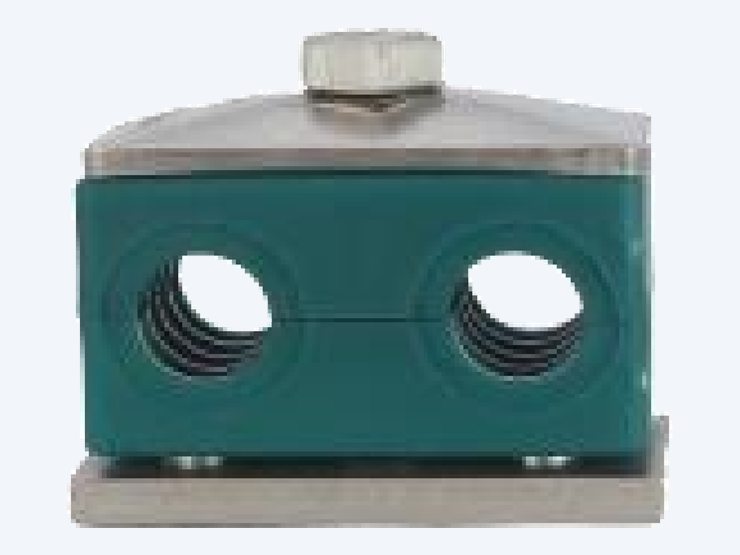
- Twin is not two standards. One body with two bores, one cover plate, one weld plate — fewer parts and less footprint on a run of paired lines.
- Above 4" the choice is made for you. Standard stops at 102 mm; only heavy reaches 406.
- No aluminium in the twin series, and none in standard groups 7 and 8. If you need the aluminium body at those sizes, it is the heavy series.
Body material and metal parts
Five body codes, five W codes. Chosen separately.
The clamp body is moulded plastic or cast aluminium, and it is colour coded — useful on site, because you can see at a glance whether a clamp is rated for the temperature it is sitting in. Tubeclo also splits each plastic into a ribbed and a smooth bore version, which is the part most often missed on an enquiry.
| Code | Material | Bore design | Colour | Temperature |
|---|---|---|---|---|
| PP | Polypropylene | Profile inside, with tension clearance | Green | −30 to +90 °C |
| PPH | Polypropylene | Smooth inside, without tension clearance | Green | −30 to +90 °C |
| PA | Polyamide | Profile inside, with tension clearance | Black | −40 to +120 °C |
| PAH | Polyamide | Smooth inside, without tension clearance | Black | −40 to +120 °C |
| ALU | Aluminium | Profile inside, with tension clearance | Aluminium | up to +300 °C |
Tension clearance is the small gap that lets the two halves close down onto the line as the bolts are tightened. The H versions do without it and grip on a smooth bore instead.
Metal parts — the W codes
Plates, bolts and rail nuts are ordered by a W code. This is the part of the specification that decides whether the assembly survives a wet or salt environment, and the part most often left off an enquiry.
| Code | Material grade | Surface |
|---|---|---|
| W1 | Carbon steel ST37 | Untreated |
| W2 | Carbon steel ST37 | Phosphated |
| W3 | Carbon steel ST37 | Zinc / nickel coated |
| W4 | Stainless steel A2 | 1.4301 / 1.4305 — AISI 304 / 303 |
| W5 | Stainless steel A4 | 1.4401 / 1.4571 — AISI 316 / 316Ti |
- W5 is the one to ask for offshore, marine or washdown — A4 stainless, AISI 316. W4 is A2, which is 304, and it does not behave the same in salt.
- W1 is untreated carbon steel. Indoors and dry only. If nobody specified a finish, this is what turns up rusty a year later.
- Body and metal parts are chosen separately — a PP body with W5 stainless hardware is a normal, sensible combination.
- On the part number this collapses to two options, C for carbon steel and SS for stainless SS316. Give us the W code as well and we will make sure the two agree.
Which group fits your tube
Size on the outside diameter, never the nominal bore.
This is the table to start from. Find your tube or pipe outside diameter, read off the group, and the bolt size and the load rating follow. A “1 inch pipe” is 33.7 mm outside, not 25.4 — and getting that wrong is the single most common ordering error on clamps.
Standard series
| Group | Tube / pipe OD (mm) | Inch equivalents | Bolt |
|---|---|---|---|
| 1 | 6 · 6.4 · 8 · 9.5 · 10 · 12 | 1/4" · 5/16" · 3/8" OD · 1/8" bore | M6 × 30 |
| 1A | 6 · 6.4 · 8 · 9.5 · 10 · 12 | as group 1, wider body | M6 × 30 |
| 2 | 12.7 · 13.5 · 14 · 15 · 16 · 17.2 · 18 | 1/2" · 5/8" OD · 1/4", 3/8" bore | M6 × 35 |
| 3 | 19 · 20 · 21.3 · 22 · 25 · 25.4 | 3/4", 7/8", 1" OD · 1/2" bore | M6 × 40 |
| 4 | 26.9 · 28 · 30 | 3/4" bore | M6 × 45 |
| 5 | 32 · 33.7 · 35 · 38 · 40 · 42 | 1 1/4", 1 1/2" OD · 1", 1 1/4" bore | M6 × 60 |
| 6 | 44.5 · 48.3 · 50.8 | 1 3/4", 2" OD · 1 1/2" bore | M6 × 70 |
| 7 | 57.2 · 60.3 · 63.5 · 70 · 73 · 76.1 | 2 1/4" to 3" OD · 2", 2 1/2" bore | M6 × 100 |
| 8 | 88.9 · 102 | 3 1/2", 4" OD · 3" bore | M6 × 125 |
Heavy series
| Group | Tube / pipe OD (mm) | Inch equivalents | Bolt |
|---|---|---|---|
| 3S | 6 to 18 | to 5/8" OD · to 3/8" bore | M10 or 3/8‑16 UNC |
| 4S | 19 to 30 | 3/4" to 1" OD · to 3/4" bore | M10 or 3/8‑16 UNC |
| 5S | 30 to 42 | 1 1/4", 1 1/2" OD · 1", 1 1/4" bore | M10 or 3/8‑16 UNC |
| 6S | 38 to 70 | to 2 3/4" OD · to 2" bore | M12 or 7/16‑14 UNC |
| 7S | 65 to 88.9 | 2 7/8", 3", 3 1/2" OD · 2 1/2", 3" bore | M16 or 5/8‑11 UNC |
| 8S | 88.9 to 133 | 3 1/2" to 5 1/4" OD · 3 1/2", 4" bore | M20 or 3/4‑10 UNC |
| 9S | 133 to 168 | 5 1/4" to 6 1/2" OD · 5", 6" bore | M24 or 7/8‑9 UNC |
| 10S | 168 to 219 | 7", 7 5/8", 8 1/2" OD · 6", 8" bore | M30 or 1 1/8‑7 UNC |
| 11S | 219 to 324 | 8", 10", 12" bore | M30 or 1 1/4‑7 UNC |
| 12S | 356 · 406 | 14", 16" bore | M30 or 1 1/4‑7 UNC |
Twin series
| Group | Tube / pipe OD (mm) | Inch equivalents | Bolt |
|---|---|---|---|
| 1D | 6 · 6.4 · 8 · 9.5 · 10 · 12 | 1/4" · 5/16" · 3/8" OD · 1/8" bore | M6 × 35 |
| 2D | 12.7 · 13.5 · 14 · 15 · 16 · 17.2 · 18 | 1/2" · 5/8" OD · 1/4", 3/8" bore | M8 × 35 |
| 3D | 19 · 20 · 21.3 · 22 · 25 · 25.4 | 3/4", 7/8", 1" OD · 1/2" bore | M8 × 45 |
| 4D | 26.9 · 28 · 30 | 3/4" bore | M8 × 50 |
| 5D | 32 · 33.7 · 35 · 38 · 40 · 42 | 1 1/4", 1 1/2" OD · 1", 1 1/4" bore | M8 × 60 |
- Twin sizes are per line, and both lines are the same size. The catalogue writes group 1D as 6/6, 3D as 19/19 — two identical bores in one body.
- Standard stays on M6 the whole way, from a 6 mm line to a 102 mm one. Only the bolt length changes, 30 mm up to 125 mm. Heavy is the series where the thread itself grows.
- Groups overlap by design at the boundaries — 30 mm appears in heavy 4S and 5S, 38 mm in 5S and 6S, 88.9 mm in 7S and 8S. Either will hold the tube; the larger group carries more load.
- Send us the OD and we will send back the group, the bolt and the load, so nothing has to be read off a table twice.
Maximum load, by group
The figure that decides body material as much as series.
Each group has a maximum load in the straight direction of the pipe, and it depends on the body material. Aluminium carries the most by a wide margin; polyamide beats polypropylene on the larger groups. Figures are kN, with the catalogue’s lbf figures alongside.
Standard series — show the maximum load table
| Group | Polypropylene | Polyamide | Aluminium |
|---|---|---|---|
| 1 | 0.6 kN 135 lbf | 0.6 kN 135 lbf | 3.5 kN 787 lbf |
| 1A | 1.1 kN 247 lbf | 0.7 kN 157 lbf | 4.2 kN 949 lbf |
| 2 | 1.3 kN 292 lbf | 0.8 kN 180 lbf | 4.3 kN 967 lbf |
| 3 | 1.4 kN 315 lbf | 1.6 kN 360 lbf | 4.9 kN 1,101 lbf |
| 4 | 1.5 kN 337 lbf | 1.7 kN 382 lbf | 5.0 kN 1,124 lbf |
| 5 | 1.9 kN 427 lbf | 2.0 kN 450 lbf | 7.3 kN 1,641 lbf |
| 6 | 2.0 kN 450 lbf | 2.5 kN 562 lbf | 8.9 kN 2,000 lbf |
| 7 | 2.3 kN 517 lbf | 3.2 kN 719 lbf | not offered |
| 8 | 2.6 kN 585 lbf | 3.5 kN 787 lbf | not offered |
Heavy series — show the maximum load table
| Group | Polypropylene | Polyamide | Aluminium |
|---|---|---|---|
| 3S | 1.6 kN 360 lbf | 4.2 kN 944 lbf | 12.1 kN 2,720 lbf |
| 4S | 2.9 kN 652 lbf | 4.5 kN 1,044 lbf | 15.1 kN 3,395 lbf |
| 5S | 3.3 kN 742 lbf | 5.1 kN 1,146 lbf | 15.5 kN 3,485 lbf |
| 6S | 8.2 kN 1,843 lbf | 9.3 kN 2,090 lbf | 29.5 kN 6,609 lbf |
| 7S | 11.0 kN 2,472 lbf | 15.8 kN 3,551 lbf | 34.9 kN 7,805 lbf |
| 8S | 14.0 kN 3,147 lbf | 21.0 kN 4,772 lbf | 50.0 kN 11,240 lbf |
| 9S | 28.0 kN 6,300 lbf | 32.0 kN 7,193 lbf | 70.6 kN 15,871 lbf |
| 10S | 40.0 kN 8,992 lbf | 48.0 kN 10,790 lbf | 84.5 kN 18,996 lbf |
| 11S | 119.0 kN 26,752 lbf | 125.0 kN 27,650 lbf | 181.5 kN 40,802 lbf |
| 12S | 168.0 kN 37,767 lbf | 180.0 kN 40,465 lbf | 244.5 kN 54,965 lbf |
Twin series — show the maximum load table
| Group | Polypropylene | Polyamide | Aluminium |
|---|---|---|---|
| 1D | 0.9 kN 202 lbf | 0.9 kN 202 lbf | not offered |
| 2D | 2.1 kN 472 lbf | 2.2 kN 495 lbf | not offered |
| 3D | 1.9 kN 427 lbf | 2.0 kN 450 lbf | not offered |
| 4D | 2.7 kN 607 lbf | 2.9 kN 652 lbf | not offered |
| 5D | 1.7 kN 382 lbf | 2.5 kN 562 lbf | not offered |
- Aluminium is not a marginal upgrade. At group 1 it carries 3.5 kN against 0.6 kN in polypropylene — nearly six times. If load is the problem, changing the body material is the cheapest fix available.
- Polyamide overtakes polypropylene from group 3 upward, and the gap widens: at 3S it is 4.2 against 1.6 kN. Below group 3 they are level or PP is slightly ahead.
- The twin series does not climb steadily. 4D is the peak at 2.7 kN in PP, and 5D drops back to 1.7 — a bigger twin clamp is not automatically a stronger one. Worth checking rather than assuming.
- Heavy is a different order of magnitude. Group 12S in aluminium takes 244.5 kN, some 400 times a group 1 PP clamp.
- These are the loads Tubeclo publishes for its own DIN 3015 clamps. They match the DIN figures, which is the point of buying to the standard — the geometry and the ratings are interchangeable, the price and the availability are not.
Tightening torque, by group
Under‑torqued the body deforms without gripping. Over‑torqued you break it on installation.
Tubeclo publishes a recommended tightening torque for every group and body material. It is the figure most often skipped on site, and the one that decides whether the clamp does its job or cracks. Pre‑tighten every bolt by hand first, then torque. Figures are N·m, with the catalogue’s ft‑lb alongside.
Standard series — show the tightening torque table
| Group | Polypropylene | Polyamide | Aluminium |
|---|---|---|---|
| 1 to 8 every group | 8 N·m 6 ft‑lb | 10 N·m 7 ft‑lb | 12 N·m 9 ft‑lb |
That is not a simplification — the catalogue prints the same three figures for every standard group from 1 to 8. The bolt is M6 throughout, so the torque does not change with size. Aluminium is not offered in groups 7 and 8, so the 12 N·m there does not apply in practice.
Heavy series — show the tightening torque table
| Group | Polypropylene | Polyamide | Aluminium |
|---|---|---|---|
| 3S | 12 N·m 9 ft‑lb | 20 N·m 15 ft‑lb | 30 N·m 22 ft‑lb |
| 4S | 12 N·m 9 ft‑lb | 20 N·m 15 ft‑lb | 30 N·m 22 ft‑lb |
| 5S | 15 N·m 11 ft‑lb | 25 N·m 18 ft‑lb | 35 N·m 26 ft‑lb |
| 6S | 30 N·m 22 ft‑lb | 40 N·m 30 ft‑lb | 55 N·m 41 ft‑lb |
| 7S | 45 N·m 33 ft‑lb | 55 N·m 41 ft‑lb | 120 N·m 86 ft‑lb |
| 8S | 80 N·m 59 ft‑lb | 150 N·m 111 ft‑lb | 220 N·m 162 ft‑lb |
| 9S | 110 N·m 81 ft‑lb | 200 N·m 148 ft‑lb | 250 N·m 184 ft‑lb |
| 10S | 180 N·m 133 ft‑lb | 350 N·m 258 ft‑lb | 500 N·m 369 ft‑lb |
| 11S | 200 N·m 148 ft‑lb | 370 N·m 273 ft‑lb | 500 N·m 369 ft‑lb |
| 12S | 270 N·m 199 ft‑lb | 450 N·m 332 ft‑lb | 600 N·m 443 ft‑lb |
Twin series — show the tightening torque table
| Group | Polypropylene | Polyamide | Aluminium |
|---|---|---|---|
| 1D | 5 N·m 4 ft‑lb | 5 N·m 4 ft‑lb | not offered |
| 2D | 12 N·m 9 ft‑lb | 12 N·m 9 ft‑lb | not offered |
| 3D | 12 N·m 9 ft‑lb | 12 N·m 9 ft‑lb | not offered |
| 4D | 12 N·m 9 ft‑lb | 12 N·m 9 ft‑lb | not offered |
| 5D | 8 N·m 6 ft‑lb | 8 N·m 6 ft‑lb | not offered |
- The heavy series is where torque really climbs — from 12 N·m at 3S to 600 N·m at 12S in aluminium. That is a 50‑fold range, and it is why a heavy clamp at the same bore as a standard one is a different job on site.
- Torque follows the body material, not just the group. At 12S it is 270 in PP, 450 in PA and 600 in aluminium — use the plastic figure on a plastic body and the aluminium figure on aluminium.
- Twin drops back at 5D, from 12 N·m to 8 N·m — the same reversal that shows in the twin load table. It is not a misprint, and it is the one twin figure worth double‑checking before you tighten.
- Twin torque is identical in PP and PA, unlike the other two series where polyamide takes more.
- Same figures as the DIN 3015 tables, so a torque spec written for one DIN 3015 clamp holds for these. We send the figure for your group and body with the order.
Send the tube OD and run length — priced within two working hours →
Reading the part number
Seven fields, and every one of them is a decision.
Tubeclo part numbers are built the same way for all three series. Once you can read one, you can re‑order without a catalogue — which is why we write the code out in full on every quotation.
| Field | What it is | Options |
|---|---|---|
| I | Type of item | PC — pipe clamp |
| II | Series | S standard · H heavy · T twin |
| III | Body material | PP · PA · AL — twin is PP and PA only |
| IV | Set configuration | 1–13 standard · 1–10 heavy · 1–6 twin |
| V | Size group | 1, 1A, 2–8 · 3S–12S · 1D–5D |
| VI | Pipe OD | Metric size in mm, e.g. 006, 021.3, 406 |
| VII | Metal parts | C carbon steel · SS stainless SS316 |
Worked example
PC‑S‑PP‑1‑3‑021.3‑C
- A pipe clamp, standard series
- Polypropylene body, so green, −30 to +90 °C
- Set configuration 1 — the complete set: clamp body, cover plate, weld plate and hex bolts
- Size group 3, so an M6 × 40 bolt and 1.4 kN maximum load
- 21.3 mm outside diameter — a 1/2 inch nominal bore pipe
- Carbon steel metal parts
Set configurations worth knowing
- 1 — complete set on all three series. Clamp body, cover plate, weld plate, bolts.
- Cover plate with rail nut set — for adding a clamp to an existing mounting rail.
- Cover plate with elongated weld plate set — where the plate is bolted rather than welded.
- Locking plate and stacking bolt set, and the double / triple stack sets, for going up a level.
- Cover plate only, weld plate only — genuine single‑part options, so a replacement does not mean a whole set.
- Set configuration numbers differ across series. Standard runs 1 to 13, heavy 1 to 10, twin 1 to 6 — and the same number means different things: heavy 3 is a double stack complete set, standard 3 is an elongated weld plate only. Always quote the series letter with it.
- One to check with us: the current standard‑series catalogue prints configurations 5 and 6 with the same description, “cover plate with rail nut set”. We confirm which is which with Tubeclo rather than guessing — tell us what it has to do and we will put the right number on the line.
The three ways it mounts
Base plate, mounting rail, or stacked.
Every Tubeclo installation is one of three methods, or a mixture. Worth deciding at drawing stage, because it fixes whether you can add a clamp later without touching the structure.
1 — Base plate
The most common. Position the base plates, check they suit the calculated loads, align, then weld them down — or use the elongated base plate and bolt it where welding is not allowed. Push the lower clamp half on, lay the line in, add the upper half and cover plate, and bolt down.
Adding a clamp later means welding another plate.
2 — Mounting rail
Position and align the rails, then weld them — or mount them on side brackets. Insert the rail nuts and turn to the stop to lock on standard and twin; on heavy they slide in instead. Then push the lower clamp half onto the nuts, lay in the line, and close with the second half, cover plate and bolts.
Clamps slide to position, and can be added or removed later without cutting or welding.
3 — Stacked
Works on either a base plate or rail nuts. Build the first level normally, then insert the stacking bolts and tighten to the recommended torque. Put a safety locking plate on top before the next clamp body — that is what stops the stacking bolts turning as the level above is tightened. Repeat, and finish the top level with a cover plate and hex bolts.
Double and triple stacks are standard configurations, not specials.
Component codes
Every accessory has its own order code, so parts can be bought individually. The codes differ by series — this is the part of an enquiry that most often needs a second phone call.
| Component | Standard | Heavy | Twin |
|---|---|---|---|
| Weld plate, single clamp | SP1–SP8 | SPAL3S–SPAL12S | SP1D–SP5D |
| Weld plate, double clamp | — | SPAS3S–SPAS12S | — |
| Elongated weld plate | SPV1–SPV8 | SPAL/DUEB3S–12S | — |
| Group weld plate | RAP1/30/10–RAP6/90/5 | — | RAP1D/40/5–RAP5D/112/5 |
| Cover plate | DP1–DP8 | DPAL3S–DPAL12S DPAS for double | GD1D–GD5D |
| Channel rail adaptor | CRA1–CRA8 | CRA3SM–CRA6M | CRA1DM–CRA5DM |
| Hexagon head bolt | AS1M–AS8M | AS3SM–AS12SM | AS1DM–AS5DM |
| Socket cap screw | IS1M–IS8M | IS3SM–IS6SM | — |
| Stacking bolt | AF1–AF8 | AF3S–AF10S | AF1D–AF5D |
| Safety locking plate | SIG1–SIG8 | SIP3S–SIP10S | SIV1D–SIV3D |
| Mounting rail | TS11 · TS14 · TS30 | STSV | TS11 · TS14 · TS30 |
| Rail nut | SM1–8/1D | GMV3–6S | SM1–8/1D · SM2–5D |
- Standard and twin share the mounting rail and rail nut. TS11, TS14 and TS30 rails, and the SM nut range covers both — so a mixed run of single and twin clamps can sit on one rail.
- The heavy series has its own rail and nut, STSV and GMV, and its nuts slide in rather than turning to a stop. Heavy parts are not interchangeable with standard.
- Stacking needs two extra parts, the stacking bolt (AF / AF-S) and the safety locking plate (SIG / SIP / SIV). Ordering the stack set gets you both.
- Socket cap screws are not offered in twin, and the heavy range stops at IS6SM — above that it is hexagon head bolts.
Where pipe clamps get used
Four duties, and what changes in the specification for each.
The clamp is the same idea everywhere, but the series, body material and metal finish change with the duty. These are the four cases we quote most often.
Pipe clamps for hydraulic systems and mobile equipment
Cranes, concrete mixers, utility vehicles, construction and agricultural machinery, machine tools. The lines run at constant high pressure and the vibration never stops, so the clamp is absorbing pressure pulsation, not just holding weight.
Usually: standard series, PP or PA body, W3 galvanized metal parts. Clamp directly behind each threaded coupling or connector, and support in front of and behind any valve.
Pipe clamps for offshore, marine and shipbuilding
Oil and gas production, onshore and offshore wind, tankers, cargo ships, cruise vessels and yachts. Lines above and below water take salt water, wind, oil, grease and wide temperature swings, and the fastening system is usually what fails first.
Usually: W5 metal parts — stainless SS316, not W3 and not W4. Ask for SS on the last field of the part number. On passenger vessels the clamp is also doing comfort work through noise and vibration reduction.
Pipe clamps for industrial piping and plant
Power plant piping, fuel lines, general industrial pipe construction, instrumentation and control, pneumatics, mining and tunnelling. High‑performance hydraulics in the least space the plant allows, and lines that still have to be maintainable.
Usually: heavy series above 4 inch, aluminium body where it runs hot, and stacked or rail‑mounted so a bank of lines fits the space. Tubeclo cites use on the Panama Canal and European railway tunnels.
Pipe clamps for vibration and noise reduction
The clamp’s real job. A ribbed bore grips along the axis of the line over a broad contact area and deadens sound rather than pinching the tube. Railway rolling stock — trains, trams, underground — is specified this way, to the European standard EN 45545, and can be milled or injected to project specification.
Usually: the ribbed PP or PA body rather than the smooth PPH or PAH, and closer spacing than the maximum. Where the line needs to move more than a rigid bore allows, the rubber insert series takes over.
- Position matters as much as part number. Tubeclo’s own guidance: put a clamp directly behind a threaded coupling or connector to take vibration off the joint, and where valves sit in the line, support both in front of and behind the valve.
- Spacing is not in the series catalogues. Tubeclo publishes sizes, loads and torques but no spacing table, so we apply DIN 3015 practice and work the clamp count from your run length and tube OD. Send both and we will do it.
Tubeclo vs Stauff — DIN 3015 equivalents, cross‑referenced
We sell both. Tubeclo is the one we recommend, and this is why.
Both are built to DIN 3015, and that is the whole point of the standard — the geometry, the groups, the sizes, the loads and the tightening torques are identical, so either drops into an existing installation. Which means the decision is not really a technical one. It comes down to availability, price and how easy the thing is to re‑order — and on all three we would put you on Tubeclo. Everything below is read from both makers’ own published tables.
| Tubeclo | STAUFF | |
|---|---|---|
| Standard series | DIN 3015‑1 · 6–102 mm · groups 1, 1A, 2–8 | DIN 3015‑1 · 6–102 mm · groups 1, 1A, 2–8 |
| Heavy series | DIN 3015‑2 · 6–406 mm · 3S–12S | DIN 3015‑2 · 6–406 mm · 3S–12S |
| Twin series | DIN 3015‑3 · 6–42 mm · 1D–5D | DIN 3015‑3 · 6–42 mm · 1D–5D |
| Body materials | PP · PA · aluminium, plus the smooth‑bore PPH and PAH | PP · PA · aluminium, plus PP with a rubber insert (RI) |
| Bore | Ribbed or smooth — the H codes drop the tension clearance | Ribbed, with the rubber insert as the softer option |
| Temperatures | PP −30/+90 · PA −40/+120 · AL +300 °C | PP −30/+90 · PA −40/+120 · AL +300 °C |
| Maximum load | 0.6 kN at group 1 PP to 244.5 kN at 12S AL | 0.6 kN at group 1 PP to 244.5 kN at 12S AL |
| Tightening torque | 8 / 10 / 12 N·m standard · to 270 / 450 / 600 at 12S | 8 / 10 / 12 N·m standard · to 270 / 450 / 600 at 12S |
| Metal part codes | W1 · W2 · W3 · W4 · W5 | W1 · W2 · W3 · W4 · W5, plus W10 and W11 mixed finishes |
| Normally offered as | W3 galvanized carbon steel ST37, or W5 stainless SS316 | The full W range, with W10 for weld plates and W11 for rail nuts |
| How you order it | One 7‑field part number, e.g. PC‑S‑PP‑1‑3‑021.3‑C | Component set codes — SP, SPV, DP, AS, IS, AF, SIG, SM |
| Set configurations | Numbered options: 13 standard, 10 heavy, 6 twin | Built up from the component codes as required |
| Spacing table published | Not in the series catalogues | Yes — by pipe OD, 1.0 m up to 7.5 m |
| Availability from us | Exclusive to us, and the line we stock most deeply | Stocked, alongside the rest of the STAUFF range |
- We lead with Tubeclo because the ratings are the same and the supply is better. We are the authorised distributor, so there is no allocation to wait on and no shared stock to compete with — which is why it is the clamp line we hold in the most depth, down to the odd groups.
- It is simpler to order and to re‑order. One 7‑field part number describes the whole assembly, against building it up from component set codes. A year later your buyer can repeat the line without ringing anyone.
- And it has an option STAUFF does not list — the smooth‑bore PPH and PAH bodies, which drop the tension clearance and grip on a smooth bore.
- Two cases where we would still say STAUFF. If your specification calls for the W10 or W11 mixed finishes — phosphated weld plate with the rest coated, or an untreated rail nut with the rest coated — those are specific to STAUFF pipe clamps. And if you want the maker’s own published spacing table to design against rather than our worked count. We stock both, so we will tell you straight which one your job needs.
- If the run is already STAUFF, you can still change over. Same standard, same groups, same bores. The one thing to check with us first is the heavy‑series rail and rail nut, the parts most likely to differ in detail between makers even where the clamp bore matches. Tell us what is on the wall and we will match the geometry.
DIN 3015 pipe clamp stock in Malaysia and Singapore
The line we stock most deeply in Malaysia, and what that means in practice.
Tubeclo is ours exclusively, so there is no allocation to wait for and no shared stock to compete with. That is why it is the clamp line we carry in the most depth — and depth on clamps means the odd groups, not just the popular ones.
| What | Coverage |
|---|---|
| Series carried | All three — standard, heavy and twin |
| Size groups across the range | 24 — 9 standard (1, 1A, 2–8), 10 heavy (3S–12S), 5 twin (1D–5D) |
| Outside diameters covered | 6 mm to 406 mm, metric and inch equivalents |
| Body materials | 5 codes — PP, PPH, PA, PAH, ALU |
| Metal part options | W3 galvanized ST37 · W5 stainless SS316 |
| Set configurations | 29 across the three series — 13, 10 and 6 |
| Stocking locations | Johor Bahru warehouse, with some orders shipping from Singapore — both our own stock, neither bought in against your enquiry |
| Lead time on a stocked item | Under three working days |
| Priced how | Landed — transport, currency, duties and taxes already inside the unit price |
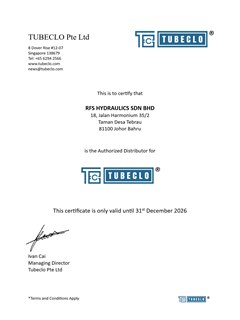
- The authorisation, in writing. Tubeclo Pte Ltd certifies RFS Hydraulics Sdn Bhd — at the Johor Bahru address above — as its Authorized Distributor. Signed by the Managing Director and valid to 31 December 2026. Download it above rather than take our word for it.
- Parts, not only sets. Clamp halves, cover plates, weld plates, rail nuts, stacking bolts and locking plates are individual line items, so adding to an existing rail costs what it should.
- Aluminium bodies, SS316 metal parts and the made‑to‑order accessories come in to order. We quote that lead time with the price rather than after it, so nothing moves after you approve.
- Where stock ships from Singapore the import tax is already in the unit price — nothing is added afterwards, and it makes no difference to what you pay.
- The brand: Tubeclo is Tubeclo Pte Ltd of Singapore and states 41 years in the trade, with clients worldwide. Four families — standard, heavy, twin and rubber insert — all to DIN 3015.
Why buy Tubeclo pipe clamps from us
One line, held deeply, priced landed.
We hold Tubeclo exclusively
It is our line, which is why we stock it more deeply than any other clamp we carry — deeper than a distributor stocks a brand it shares. That shows up as availability on the odd group, not just the popular ones.
DIN 3015, so it is interchangeable
Same three parts of the standard, same groups, same size reach to 406 mm, same published loads. It drops into an existing DIN 3015 installation — you are not committing the whole plant to a new geometry.
We work out the count
Send the run length and the tube size and we return the clamp count, not a unit price. On small tube the number of clamps matters more than the price of one.
Group checked against the load
Tell us the duty and we pick the series and body material against the load table rather than defaulting everything to standard PP — and we say so on the quotation.
The part number, written out
Every line comes back as a full seven‑field code. Re‑order next year without ringing us, and without anyone guessing at the set configuration.
Stock on both sides of the causeway
Johor Bahru and Singapore, at a landed price — transport, currency, duties and taxes already inside the figure. Under three working days on a stocked item.
Questions we get asked
The ones that come up on the phone.
What is a Tubeclo tube clamp actually for?
Holding a tube, pipe, hose or cable still — and more importantly reducing the mechanical shock and vibration that flowing fluid creates before that energy reaches a fitting or a weld. A run that is not properly clamped works its joints loose over time. The body is a square block with a ribbed bore, and the ribs are what give both the grip and the sound deadening.
Do I size the clamp on the pipe bore or the outside diameter?
Outside diameter, always. The clamp closes around the outside of the line, so the bore of the clamp matches the tube or pipe OD. This is the most common ordering error on clamps: a “1 inch pipe” is 33.7 mm outside, not 25.4, and it needs the group that covers 33.7 — standard group 5, not group 3. Every group and its sizes.
Standard, heavy or twin — which do I need?
Load and vibration decide it, not size. Standard (6–102 mm) for average load and moderate vibration — mobile equipment, machine tools, instrumentation. Heavy (6–406 mm) for higher load and vibration — mining, metal plant. Twin (6–42 mm) where two lines run close together and one body with two bores saves parts and space. They overlap heavily below 42 mm, so tell us the duty.
What do PPH and PAH mean?
They are the smooth‑bore versions. PP and PA have a profiled (ribbed) bore with tension clearance; PPH and PAH are smooth inside, without tension clearance. Tension clearance is the small gap that lets the two halves close down onto the line as the bolts pull up. Same materials, same colours, same temperatures — different grip. If you have been quoted PPH and expected PP, that is the difference. The five body codes.
What do the colours mean?
The body material, and therefore the temperature. Green is polypropylene, −30 to +90 °C. Black is polyamide, −40 to +120 °C. Silver is aluminium, up to +300 °C. It is a genuinely useful convention on site — you can see at a glance whether a clamp is rated for where it is sitting.
Which body material carries the most load?
Aluminium, by a wide margin. At group 1 it takes 3.5 kN against 0.6 kN in polypropylene — nearly six times. Polyamide overtakes polypropylene from group 3 upward and the gap widens with size. So if load is the constraint, changing the body material is usually cheaper than changing series. Note aluminium is not offered in standard groups 7 and 8, nor anywhere in the twin series. Load tables.
Is a bigger twin clamp always stronger?
No, and this one catches people. In the twin series the maximum load peaks at group 4D — 2.7 kN in PP, 2.9 in PA — and then drops back at 5D to 1.7 and 2.5. Group 2D at 2.1 kN also beats 3D at 1.9. So on twin you have to read the load table rather than assume it rises with the group number. The twin table.
What bolt size does each clamp take?
On the standard series it is M6 right across the range, from group 1 to group 8 — only the length changes, 30 mm up to 125 mm. The heavy series grows the thread with the clamp: M10 at 3S to 5S, M12 at 6S, M16 at 7S, M20 at 8S, M24 at 9S and M30 from 10S to 12S. Twin uses M6 at 1D and M8 from 2D up. UNC equivalents are published alongside. Full list.
What does the SS at the end of the part number mean?
The metal parts. SS is stainless SS316; C is carbon steel. That is the last of the seven fields. The catalogue also uses W codes for the surface finish in more detail — W5 is A4 stainless, AISI 316/316Ti, and W4 is A2, which is 304 and not the same thing in salt. If you are specifying for marine or washdown, ask for SS316 / W5 explicitly. The W codes.
Can I add clamps to a run later?
Yes, if you design for it. Use a mounting rail: weld the rail once, and clamps then position anywhere along it on rail nuts, added or removed without touching the structure. On standard and twin the rail nut is inserted and turned to a stop to lock; on heavy it slides in. On a base‑plate installation, adding a clamp means welding another plate. All three methods.
Can I stack clamps on top of each other?
Yes — that is one of the reasons to pick Tubeclo. With stacking bolts and safety locking plates, identical bodies mount directly on top of one another, so lines running close together need not sit side by side. The locking plate goes between levels to stop the stacking bolts turning as the next level is tightened, and the top level finishes with a cover plate and hexagon bolts. Stacks work on either a base plate or rail nuts, and double and triple stack sets are standard configurations.
Do you deliver to Singapore, and what does delivery cost?
Yes. We hold stock in Johor Bahru and Singapore, and a stocked item can be delivered in under three working days. Our quote is a landed price — transport, currency, duties and taxes are already in the figure, so what you approve is what you pay. Aluminium bodies, SS316 metal parts and the made‑to‑order accessories come in to order and we quote that lead time with the price.
How tight should the bolts be?
To the figure for your series, group and body material. On the standard series it is 8 N·m in PP, 10 in PA and 12 in aluminium, and that is the same for every group from 1 to 8 because the bolt is M6 throughout. The heavy series climbs with size, to 270 / 450 / 600 N·m at group 12S. Pre‑tighten every bolt by hand first, then torque. Under‑torqued and the body deforms without developing clamping force; over‑torqued and you crack the clamp on installation. Full tables.
Which group do I need for a 1/2 inch pipe?
It depends whether you mean 1/2 inch nominal bore pipe or 1/2 inch tube, and they are different clamps. A 1/2 inch NB pipe is 21.3 mm outside — that is standard group 3, heavy 4S or twin 3D. A 1/2 inch tube is 12.7 mm outside — standard group 2, heavy 3S or twin 2D. Send us the outside diameter in millimetres and the ambiguity disappears. Every group and its sizes.
Can Tubeclo clamps replace STAUFF clamps on an existing run?
Yes, in the great majority of cases. Both are built to DIN 3015, so the series, the groups, the bores, the loads and the torques are the same — a group 4S clamp is a group 4S clamp. Where you should check with us first is the heavy‑series mounting rail and rail nut, which are the parts most likely to differ in detail between makers even when the clamp bore matches. Tell us what is already on the wall and we will match the geometry. Full comparison.
Do you supply the clamps with stainless steel plates and bolts?
Yes. The metal parts come as W3 galvanized carbon steel ST37 or W5 stainless SS316, and on the part number that is the last field — C for carbon steel, SS for stainless. For marine, offshore or washdown, ask for SS316 / W5 explicitly, and do not accept W4 as equivalent: W4 is A2, which is AISI 304, and it does not behave the same in salt. Stainless comes in to order and we quote that lead time with the price. The W codes.
Can I mount the clamps without welding?
Yes, two ways. Use the elongated weld plate, which is drilled so it can be bolted down with hex bolts or cap screws instead of welded. Or mount a mounting rail on side brackets and drop the clamps onto rail nuts along it. The rail route is the better one if the layout might change — clamps then slide to position and can be added or removed later without touching the structure. Both are standard set configurations, not specials. The three methods.
How many clamps will I need?
That comes from the run length and the tube outside diameter, and on small tube it matters far more than the price of one clamp. Tubeclo publishes sizes, loads and torques but no spacing table in the series catalogues, so we apply DIN 3015 practice: small tube wants a clamp roughly every metre, and spacing opens out to several metres on large pipe. Close it up at bends, valves and pumps, and put one directly behind each threaded coupling. Send the run length and the OD and we will give you the actual count rather than a rule of thumb.
Can I buy a single part, or only complete sets?
Single parts. The set configurations include genuine single‑item options — cover plate only, weld plate only, elongated weld plate only — so replacing one damaged plate does not mean buying a whole clamp. Clamp halves, rail nuts, stacking bolts and safety locking plates are all individual line items too, which is what makes adding to an existing rail cost what it should. Quote the series letter with the configuration number, because the numbering is not the same across series. Reading the part number.
Will these hold hose and cable, or only steel pipe?
All of them. The clamp is rated for tube, pipe, hose and cable, and Tubeclo states the design is compatible with cable trays as well. What matters is the outside diameter of whatever you are clamping, not what it is made of — measure the hose over its cover and order the group that covers that figure. On hose, the ribbed PP or PA bore is usually the right choice; where the line needs to move more than a rigid bore allows, the rubber insert series takes over.
How far apart should the clamps be spaced?
Close enough that the tube cannot vibrate between supports or sag under its own filled weight — small‑bore lines need closer spacing than large ones, and every line needs a clamp near pumps, valves and bends, where pressure pulses work the joints hardest. The catalogue does not print a spacing table and we will not invent one: send the tube OD, the working pressure and the run layout, and we will recommend the spacing and the number of clamps with the quotation.
Which body material and hardware suit my environment?
Rule of thumb: PP bodies for general indoor duty to +90 °C; PA where the line runs colder or hotter (−40 to +120 °C); aluminium up to +300 °C beside hot lines. Then pick the hardware, because the plates and bolts corrode long before the polymer body does: galvanized steel for dry indoor plant, stainless steel for coastal, offshore, washdown and chemical environments — in Singapore marine yards and on Malaysian coastal sites, stainless hardware is what survives. If in doubt, send us a photo of the installation.
Catalogues
Direct PDF download — no form, no email address. One per series.
 Standard series — groups 1 to 8, every size, load and component codeTubeclo · 3.7 MBPDF
 Heavy series — groups 3S to 12S, to 406 mmTubeclo · 59 MBPDF
 Twin series — groups 1D to 5D, two lines per clampTubeclo · 22 MBPDF
The heavy catalogue is 59 MB — worth knowing before you open it on mobile data. Ask us and we will send the two or three pages you actually need.
Related: STAUFF pipe clamps as the alternative to DIN 3015 · rubber insert clamps where the line needs a softer grip · anti‑corrosion clamps for marine and washdown · hydraulic steel tube and stainless steel tube to clamp · compression fittings for the joints between.
Send the tube OD and the run length
We will read off the group, pick the series and body against the load, work out the clamp count and quote a landed price with the full part number on every line. Stock in Johor Bahru and Singapore.